
What Is PUREcleaning, and How Does Maid Brigade Make Its Cleaning Agents On Site?
By Maid Brigade of Greater Fort Worth, serving Fort Worth and the Mid-Cities since 1989. Editorial verification September 9, 2026.
Last updated: 2026-09-09
Verified against United States Environmental Protection Agency guidance on pesticide devices and antimicrobial registration, Centers for Disease Control and Prevention cleaning and disinfection guidance, and the peer-reviewed EWASH hospital trial in the National Library of Medicine on September 9, 2026. All Maid Brigade product descriptions are quoted from the company’s own published pages as of that date and are labelled as company claims, not as independent findings. Desk verification of published sources is the method used here.
TL;DR: PUREcleaning is Maid Brigade’s name for making its own cleaning agents on site from salt, water, and electricity rather than buying them pre-mixed. Electrolysis splits the salt solution into sodium hydroxide, a general-purpose cleaner, and hypochlorous acid, a disinfectant that peer-reviewed hospital research measured at 84.8 percent microbiological cleanliness against 87.3 percent for bleach. The company states it refreshes these daily.
Three things make people suspicious of a proprietary cleaning name. It sounds invented, because most of them are. It usually has no published mechanism behind it. And nobody tells you what the system cannot do. PUREcleaning is unusual in that the mechanism is ordinary, documented electrochemistry rather than a secret formula, and the honest limits are knowable. In a double-blind hospital trial the active ingredient reached 84.8 percent microbiological cleanliness against 87.3 percent for bleach.
This guide covers the process step by step, the two liquids it produces, what the regulatory picture genuinely allows a company to claim, why freshness is the whole ballgame, and the questions to put to any company running a system like it.
What is PUREcleaning?
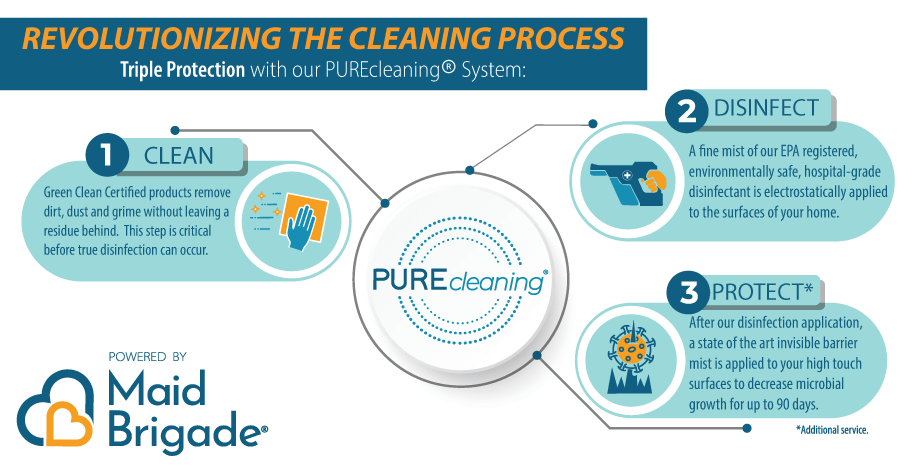
PUREcleaning is the name Maid Brigade uses for its on-site cleaning system, in which the cleaning and disinfecting agents are generated at the company’s own facility rather than purchased pre-mixed. The company describes making its agents “using salt, water, and electricity” and states that it makes its products in-house and refreshes them daily.
The practical consequence is a much shorter supply chain than conventional janitorial chemistry. There is no concentrate shipped across the country, no dilution step performed differently by different people, and no jug of surfactant sitting in a garage. What arrives at your home is a solution made from three inputs a few days earlier at most.
How does the on-site process actually work?
The process is electrolysis, the same reaction taught in secondary school chemistry. A solution of ordinary salt and water is passed through a cell containing two electrodes carrying opposite electrical charges. The dissolved salt separates into sodium and chloride, each of which is drawn toward the electrode carrying the opposite charge.
At the positive electrode, chloride reacts to form hypochlorous acid. At the negative electrode, sodium reacts to form sodium hydroxide. The cell keeps the two streams separate, which is what makes this a manufacturing process rather than simply electrified salt water. The result is two liquids with two distinct jobs, drawn from three inputs that cost almost nothing and ship as a bag of salt.
What are the two liquids and what does each one do?
One cleans, one disinfects, and confusing them is the most common mistake people make when they read about this chemistry. The alkaline stream, sodium hydroxide, is the general-purpose cleaner: it breaks down oils, grease, and the sticky films that hold soil to a surface. Maid Brigade refers to its multi-surface cleaner as Magic Water and states that it “emulsifies dirt and leaves no residue behind.”
| Stream | Chemical | Job | Where it is used |
|---|---|---|---|
| Alkaline | Sodium hydroxide | General-purpose cleaning | Counters, floors, appliance exteriors, general surfaces |
| Acidic | Hypochlorous acid | Light cleaning and disinfection | High-touch points, bathrooms, kitchen contact surfaces |
| Both | Generated from salt, water, electricity | Replace conventional multi-product chemistry | Routine visits, no client-supplied products |
| Neither | Acid descaler | Dissolving mineral scale | Not covered by this system |
| Neither | Abrasive or solvent | Baked-on or adhesive soils | Not covered by this system |
| Order | Clean first, then disinfect | Required sequence | Every surface being disinfected |
The last three rows matter as much as the first two. The Centers for Disease Control and Prevention is explicit that a surface must be cleaned before it is disinfected, since “impurities like dirt may make it harder for sanitizing or disinfecting chemicals to kill germs”. A system that produces both liquids still has to apply them in the right order.
What can a company legitimately claim about on-site generated agents?
Less than most marketing implies, and this is worth understanding before you evaluate anyone’s claims. Under federal law, equipment that generates a substance is regulated as a device rather than as a pesticide product, and the Environmental Protection Agency states plainly that “FIFRA does not require registration of devices”.
That distinction has teeth. The EPA warns that an establishment number on device packaging “does NOT indicate that the product has been reviewed for safety or efficacy by EPA, nor does it imply EPA product approval, registration, certification, or endorsement”. A registered pesticide product carries an EPA registration number and has submitted efficacy data. A device carries only an establishment number and has not. Neither fact makes on-site generation bad. It means the supporting evidence for the chemistry comes from the published research literature rather than from a registration file, which is why the hospital trial matters so much here.
Is the hospital grade description accurate?
Maid Brigade describes the electrolyzed water it uses as a hospital grade disinfectant, and that is the company’s own description, quoted here as such rather than independently verified. The term itself has a specific technical meaning worth knowing. The EPA defines a hospital disinfectant as “a disinfectant that is a general or broad-spectrum disinfectant and also is effective against the nosocomial bacterial pathogen Pseudomonas aeruginosa”.
Because that definition attaches to registered products and their submitted efficacy data, the honest way to read any company’s use of the phrase is as a description of the chemistry class rather than as a certification of the specific liquid in the bottle. The independent support for hypochlorous acid comes from research: the double-blind trial led by Giorgia Gon of the London School of Hygiene and Tropical Medicine concluded that “HOCl and sodium hypochlorite have a similar efficacy in achieving microbiological cleanliness, with HOCl acting at a lower concentration”. The full treatment of the term is in what does hospital grade disinfectant actually mean for a house cleaning.
Why does the daily refresh matter so much?
Because hypochlorous acid is unstable, and a system that generates it on site but stores it for months has thrown away its own advantage. The compound degrades with exposure to light, air, and heat. Potency falls over weeks, which means an old solution can look and smell identical to a fresh one while doing substantially less.
This is why the refresh schedule, not the generation equipment, is the claim worth interrogating. Maid Brigade states that it makes its products in-house and refreshes them daily. Any company advertising electrolyzed water should be able to answer the same question in the same specific terms. If the answer is vague, or if the solution arrives pre-bottled from a supplier, the system being described is a different one. A free, no-obligation quote is a reasonable moment to ask.
Does the system handle hard water scale in a Fort Worth home?
No, and this is the clearest limit of the chemistry. Fort Worth’s own water quality reporting puts total hardness at 138 to 178 parts per million, or 8 to 10 grains per gallon, which sits inside the hard band on the United States Geological Survey scale.
That means local homes accumulate calcium carbonate on shower doors, faucets, and glass regardless of how well they are cleaned. Neither sodium hydroxide nor hypochlorous acid dissolves mineral scale, because scale is not soil and not a microorganism. Removing it takes an acid descaler or mechanical removal, covered in hard water and mineral buildup in Fort Worth homes. A cleaning company that promises a green chemistry system will erase existing scale is overpromising.
What does Maid Brigade of Greater Fort Worth do differently?
The distinguishing choice is running this chemistry as the routine system rather than as a premium add-on. The company states that its PUREcleaning service and products are “environmentally friendly, non-toxic, non-irritant and safe for you, your family and pets”, that it applies agents using Electrostatic PUREmist sprayers, and that its cleaning agents are free from harsh odors.
Two operational details support the chemistry. Crews arrive fully equipped, so a household buys and stores nothing, and they work a multi-fiber cloth system intended to prevent cross-contamination between rooms. The company also describes itself as the first maid service in the United States to switch entirely to green cleaning products, which is its own account of its history rather than an audited certification. Locally owned and family operated since 1989, it serves Fort Worth alongside Hurst, Euless, Bedford, Colleyville, North Richland Hills, Keller, Southlake, Grapevine, Watauga, and Haltom City. To ask what would be used in your home specifically, book a visit.
How do Fort Worth homeowners actually decide?
Almost nobody selects a cleaning service on electrochemistry. The chemistry becomes decisive only when a specific person in the house makes it decisive: an infant crawling on floors, a parent on immunosuppressants, a dog that grooms itself after walking across a freshly cleaned kitchen.
For those households the useful questions are short and concrete. Is the solution generated on site or delivered pre-bottled? How often is it replaced? Which liquid cleans and which disinfects, and in what order are they applied? Is the disinfectant left wet long enough to work? Is any independent evidence offered, and is it about this product or about the chemistry class? A company running the real system answers all five plainly. The broader version of that interrogation is in how to vet a green cleaning company and avoid greenwashing in the Mid-Cities, and the underlying chemistry is explained in what is electrolyzed water cleaning and how does it actually work.
Key Takeaways
- PUREcleaning is Maid Brigade’s name for generating its cleaning agents on site from salt, water, and electricity rather than buying them pre-mixed.
- Electrolysis produces two separate liquids: sodium hydroxide for general-purpose cleaning and hypochlorous acid for light cleaning and disinfection.
- Equipment that generates a substance is a device under federal law, and the EPA states that devices are not registered and that an establishment number does not indicate any EPA review of safety or efficacy.
- The independent evidence for this chemistry comes from published research rather than a registration file, including a double-blind hospital trial measuring 84.8 percent cleanliness for hypochlorous acid against 87.3 percent for bleach.
- Hypochlorous acid degrades with light, air, and heat, so the refresh schedule is the claim worth interrogating rather than the generation equipment itself.
- Neither liquid dissolves hard water scale, which matters in Fort Worth because the city reports total hardness of 8 to 10 grains per gallon.
FAQ
What does PUREcleaning actually mean?
It is Maid Brigade’s name for its on-site cleaning system, in which cleaning and disinfecting agents are generated at the company’s own facility from salt, water, and electricity rather than bought pre-mixed. The company states that it makes its products in-house and refreshes them daily. The underlying process is electrolysis, which splits a salt solution into an alkaline cleaner and an acidic disinfectant, each with a distinct job.
Is PUREcleaning EPA registered?
Equipment that generates a substance is regulated as a device rather than as a pesticide product, and the EPA states that federal law does not require registration of devices. That means the question itself is slightly misdirected. The relevant evidence for on-site generated hypochlorous acid comes from the published research literature rather than from a product registration file. Ask any company which specific claim it is making and what evidence supports it, rather than assuming a registration number exists.
How is this different from ordinary green cleaning products?
Most green cleaning products are still manufactured elsewhere, shipped as concentrate, and diluted on arrival, which means the supply chain, the packaging, and the dilution variability are all still present. Generating agents on site removes those steps and reduces the chemistry to three inputs. Whether that matters to you depends on what you are trying to avoid: plastic and transport, chemical residue, strong odors, or all three.
Does the system disinfect and clean at the same time?
No, and no legitimate system does. Cleaning and disinfecting are separate steps with separate chemistry, and the CDC is explicit that surfaces must be cleaned first because dirt makes it harder for disinfecting chemicals to kill germs. A system generating two liquids still has to apply the cleaner first and the disinfectant second, and the disinfectant has to stay wet on the surface long enough to work.
Will it remove the cloudy film on my shower glass?
Not on its own. That film is almost always calcium carbonate scale from hard water, and Fort Worth reports total hardness of 138 to 178 parts per million, which is inside the hard band on the USGS scale. Scale is a mineral deposit rather than soil or a microorganism, so it requires an acid descaler or mechanical removal. Ask specifically about descaling if that is the problem you want solved.
Do I need to buy anything or leave supplies out?
No. Maid Brigade states that its crews arrive fully equipped, which means the household buys nothing, stores nothing, and does not need to leave products or equipment available. This is one of the practical consequences of a company generating and carrying its own chemistry, and it is worth confirming with any company you consider, since arrangements differ between companies and independent cleaners.
Bottom Line
PUREcleaning is a supply-chain and chemistry choice rather than a secret formula: salt, water, and electricity, split into a cleaner and a disinfectant, made close to the point of use and, the company states, refreshed daily. The chemistry has real peer-reviewed support, the regulatory picture is narrower than most marketing suggests, and the system will not touch hard water scale. Ask where the solution is made, how often it is replaced, and what evidence backs the specific claim being made. If you want that answered for your own home, contact the office or request a free quote.
Sources
- What is electrolyzed water cleaning and how does it actually work for the underlying chemistry in full.
- What does hospital grade disinfectant actually mean for a house cleaning for the regulatory meaning of the term.
- Is electrolyzed water cleaning safe for kids and pets for the household safety question.
- Hard water and mineral buildup in Fort Worth homes for the limit this chemistry cannot cross.
- How to vet a green cleaning company and avoid greenwashing in the Mid-Cities for interrogating any green claim.
- United States Environmental Protection Agency, pesticide devices guide for consumers: devices are not registered under FIFRA, and an establishment number does not indicate EPA review of safety or efficacy.
- United States Environmental Protection Agency, antimicrobial product registration guidance: the definitions of limited, general, and hospital disinfectants.
- EWASH trial, National Library of Medicine: the double-blind comparison of hypochlorous acid against sodium hypochlorite and the researchers’ conclusion.
- Centers for Disease Control and Prevention, when and how to clean and disinfect: the requirement to clean before disinfecting.
- City of Fort Worth 2022 Water Quality Report: total hardness of 138 to 178 parts per million, or 8 to 10 grains per gallon.