How to Vet a Green Cleaning Company and Avoid Greenwashing in the Mid-Cities
By Maid Brigade of Greater Fort Worth, serving Fort Worth and the Mid-Cities since 1989. Editorial verification September 10, 2026.
Last updated: 2026-09-10
Verified against Green Seal and the United States Environmental Protection Agency on September 10, 2026. Every external link in this guide was checked live during that review and the cited pages re-read where they permit automated access; dead citations found in that sweep were replaced or removed. Desk verification of published sources is the method used, and no laboratory or in-home testing was performed for this guide.
TL;DR: To tell a genuinely eco-friendly cleaning company from a greenwashed one, run three checks: ask what specifically is in the products and to see the labels, ask who verifies the claim and how you can look it up yourself, and ask whether the same products are used on every visit or swapped when a stain is stubborn. Vague words like green, natural, and eco-friendly mean nothing on their own. Specific, checkable mechanisms mean everything.
Every cleaning company in the Mid-Cities calls itself green. The word costs nothing to print, no one is checking, and the homeowner asking the question usually has a real reason for asking: a child with asthma, a dog that licks the floor, a chemical sensitivity that turns a bad product choice into a bad week. That is what makes this category worth scrutiny. The standard governing these claims is also stricter than most companies behave as though it is: under the Federal Trade Commission’s Green Guides, a marketer should not make unqualified claims such as green or eco-friendly at all, because consumers cannot interpret them accurately, and a non-toxic claim specifically requires defensible scientific evidence about toxicity in humans and in the environment. This guide gives you the three questions that separate a real answer from a slogan, and it applies them to Maid Brigade too.
How do you know if a cleaning company is actually eco-friendly?
Run three checks. First, ask what is actually in the products and whether you can see the labels. Second, ask who verifies the claim and how you could look that up independently. Third, ask whether those same products are used on every visit, or whether the crew reaches for something harsher when a stain resists. A company that answers all three with specifics is telling the truth. A company that answers with adjectives is selling one.
The underlying principle is simple: a claim you cannot check is not a claim, it is a mood. Everything below is a way of turning a mood back into something checkable.
What is greenwashing in the house cleaning industry?
Greenwashing is using environmental language that sounds meaningful but carries no verifiable substance: green, natural, eco-friendly, or non-toxic with no named ingredient, no independent verification, and no way for a customer to confirm any of it. In cleaning, it usually shows up as a leaf on a van and nothing behind it.
The Federal Trade Commission’s Green Guides, which govern environmental marketing claims in the United States, treat this directly. A legal analysis of the revised guides notes that companies should not make claims such as green or eco-friendly without qualification, because consumers find it difficult to interpret these claims accurately and a company cannot substantiate the many meanings a consumer might reasonably take from them. The same analysis notes that non-toxic claims in particular require defensible scientific evidence, both related to toxicity levels in humans and in the environment.
That standard is worth holding in your head for the rest of this article, including the section about Maid Brigade. Any company describing its own products, this one included, is making a self-description. The question is always whether there is something specific underneath it that you can examine.
What questions expose a greenwashed cleaning claim?
Three questions do most of the work, and the difference between answers is stark rather than subtle.
| What you ask | Greenwashed answer | Substantive answer | How you check it |
|---|---|---|---|
| What is in the products? | “They’re plant-based and eco-friendly.” | Names the actual active agents and what each is used for | Ask to see a label on the first visit and read it |
| Who verifies that? | “We’re certified green.” | Names the certifying body, or says plainly that it self-describes and explains the mechanism instead | Look the certifier up yourself; a real one has public standards |
| Do you always use them? | “Yes, always.” | Explains what happens with a stubborn stain and whether anything harsher ever comes out | Ask what is in the crew’s caddy for worst-case jobs |
| Where do the products come from? | Vague or unanswered | Names the source, supplier, or on-site process | Ask to see the container and where it was filled |
The third question is the one almost nobody asks and the one that catches the most companies. Plenty of services genuinely use gentler products for routine work and keep something conventional in the caddy for the jobs those products will not handle. That is a defensible practice. Quietly presenting it as fully green cleaning is not.
What does a legitimate green cleaning certification actually check?
A real certification audits process, not just products. Green Seal, the nonprofit that certifies cleaning services under its GS-42 standard, evaluates five specific areas: cleaning equipment and procedures, the chemicals used, employee training requirements, product labeling, and communication practices, and it verifies compliance through on-site inspections before awarding certification.
“Cleaning service providers who meet Green Seal’s rigorous health and environmental criteria are uniquely qualified to provide exceptional cleaning and disinfection while also protecting indoor air quality and respiratory health for the building occupants,” says Doug Gatlin, CEO of Green Seal.
Notice what that list contains: training and procedures, not only chemistry. That is the tell of a real standard. A certification that only looks at bottles misses the fact that a good product used badly is not a green clean. When a company names a certifier, look the certifier up. It should have published standards you can read, a searchable directory, and an audit process. If none of that exists, the badge is decoration.
How do you check a company’s products yourself?
Ask to see a label on the first visit and read the active ingredients. This is the single most useful thing a homeowner can do, it takes two minutes, and almost nobody does it. A company confident in what it uses will hand you the bottle. A company that deflects has answered your question.
For products carrying a third-party mark, verify the mark rather than trusting it. The EPA’s Safer Choice program maintains a searchable public database of certified products, filterable by product type and even by fragrance-free formulation, and other legitimate certifications are similarly searchable. The point is not that certified products are the only acceptable option. It is that a claim tied to a public, searchable registry can be confirmed in thirty seconds, while a claim tied to nothing cannot be confirmed at all. If a company’s green claim rests on a certification, that certification should survive a search. If it rests on a mechanism, the mechanism should survive a reading.
What should you ask about the process, not just the products?
Ask who trains the crews, whether cloths are separated between bathrooms and kitchens, and what equipment gets used where. Green cleaning is a process claim as much as a chemistry claim, which is why the GS-42 standard covers training and procedures alongside chemicals.
Cross-contamination is the most common gap. A single cloth carried from a toilet to a kitchen counter undoes any benefit the product provided, regardless of what is in the bottle. Ask whether the company uses a color-coded or multi-fiber cloth system that keeps areas separate, and ask how often cloths are changed within a single home. These questions also happen to identify companies that take the work seriously in general, which is why they are worth asking even if the environmental angle is not your primary concern. Whether gentler products can genuinely disinfect is a fair follow-up, and can eco-friendly cleaning actually disinfect and kill germs gives the honest answer.
What if a company has no certification at all?
A missing certification is not automatically a red flag, and a present one is not automatically proof. Certification programs cost money and carry administrative overhead, and plenty of small and mid-sized local companies use genuinely gentler methods without carrying a formal mark. What matters is whether something specific and checkable sits underneath the claim.
The honest hierarchy runs like this. Best is a named certifier with public standards you can look up. Equally strong in practice is a specific, named mechanism you can research independently and observe in your own home. Weakest, and effectively meaningless, is an unqualified adjective with neither behind it. A company that says “we use hypochlorous acid generated on site, here is the label, here is what it is for” has given you more to verify than a company displaying a badge from an organization that turns out to have no published standard. Judge the specificity, not the sticker.
What does Maid Brigade of Fort Worth actually claim, and how can you check it?
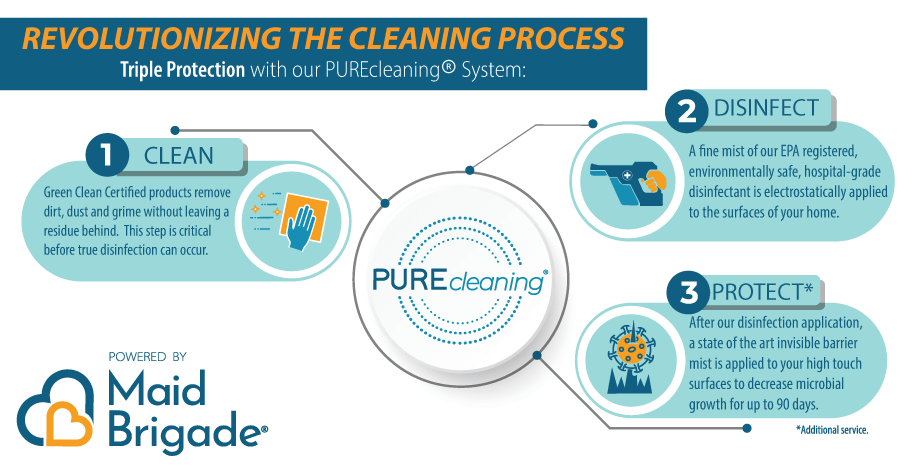
Maid Brigade of Greater Fort Worth sits in the second category above: it publishes a mechanism rather than leading with a badge. The company states that it makes its cleaning agents on site from salt, water, and electricity, producing hypochlorous acid for light cleaning and disinfection and sodium hydroxide for general-purpose cleaning. It describes this system as PUREcleaning, refers to its multi-surface cleaner internally as Magic Water, says the products are made in house and refreshed daily, and states that its cleaning agents are free from harsh odors. It also uses a multi-fiber cloth system intended to prevent cross-contamination, which addresses the process question above rather than only the chemistry one.
Applying this article’s own standard honestly: the company’s description of those products as environmentally friendly, non-toxic, non-irritant and safe for you, your family and pets is the company’s own wording, not an independent laboratory finding, and you should treat it the way you would treat any company’s self-description. What distinguishes it from a generic green claim is that hypochlorous acid and electrolyzed water are specific, named, well-documented chemistry you can research on your own before anyone enters your house, and the crew can hand you the container on the first visit. That is a claim built to be checked. Maid Brigade also states that it was the first maid service in the United States to switch to entirely sustainable, responsible green cleaning products, which is likewise the company’s own account of its history.
If you want to pressure-test it, do exactly what this article recommends for everyone: request a free quote, ask what will be used in your home, and ask to see it on the first visit. Is electrolyzed water cleaning safe for kids and pets covers the mechanism in more depth if you want to read up before asking.
How do Mid-Cities homeowners actually vet a green cleaner?
The realistic version is not a research project. Most people in Colleyville, Southlake, Keller, Hurst, and North Richland Hills who care about this end up doing three things: asking the product question during the quote call, reading one label on the first visit, and watching whether the same products keep appearing over the following months.
That third step is the one that actually settles it, and it costs no effort. Consistency over several visits is harder to fake than any answer given on the phone. Households with a specific trigger, whether that is a child’s asthma, a chemical sensitivity, or a pet that spends its life on the floor, tend to add one more step: naming the concern explicitly at booking so it goes on the work order rather than depending on which crew arrives. If your reason for asking is pets specifically, which house cleaning products are actually pet-safe covers what to avoid. You can also compare what any company tells you against the published services list rather than relying on memory from a phone call.
To put these three questions to a local company, request a free quote and ask specifically what will be used in your home.
To put these questions to a real person rather than a web page, contact the office.
Key Takeaways
- Three checks separate a genuine green cleaner from a greenwashed one: what is actually in the products, who verifies it and how you can look it up, and whether the same products are used on every visit.
- The FTC’s Green Guides discourage unqualified claims like green or eco-friendly precisely because consumers cannot interpret them accurately and companies cannot substantiate every reasonable meaning.
- A legitimate certification audits process as well as chemistry, which is why Green Seal’s GS-42 standard covers equipment, procedures, training, labeling, and communication, verified by on-site inspection.
- The question almost nobody asks is what happens with a stubborn stain, and it catches companies that quietly keep something harsher in the caddy.
- A missing certification is not automatically a red flag, because a specific named mechanism you can research independently is stronger evidence than a badge from an organization with no published standard.
- Any company’s description of its own products, including Maid Brigade’s, is a self-description, and the right response is to ask to see a label on the first visit.
FAQ
What does greenwashing mean when a cleaning company does it?
Greenwashing in house cleaning means using environmental language that sounds meaningful but has nothing verifiable behind it: calling a service green, natural, or eco-friendly with no named ingredients, no independent verification, and no way for a customer to confirm anything. The FTC’s Green Guides discourage unqualified claims of this kind because consumers cannot interpret them accurately. In practice it looks like a leaf logo and confident language, with no answer when you ask what is actually in the bottle.
How can I verify a cleaning company’s green certification myself?
Ask which organization issued the certification, then look that organization up independently rather than trusting the badge. A legitimate certifier publishes its standards, explains what it audits, and maintains a searchable directory of certified companies or products. Green Seal, for example, publishes the GS-42 standard for cleaning services and conducts on-site inspections. If you cannot find published standards or a way to confirm the company appears on the certifier’s list, treat the badge as decoration rather than evidence.
Do green cleaning products actually clean as well as conventional ones?
This depends heavily on the specific product and the specific job, and it is a question worth putting to any company directly rather than accepting a general reassurance from either direction. The more useful question is what a company does when a routine product will not handle something, because that answer reveals whether the green claim covers every visit or only the easy ones. Ask what is in the crew’s caddy for worst-case jobs and how the company decides to escalate.
Is a company without a green certification automatically worse?
No. Certification programs carry real cost and administrative overhead, and many capable local companies use genuinely gentler methods without carrying a formal mark. What matters is whether something specific sits underneath the claim. A company that names its actual cleaning agents and can show you a label has given you more to verify than one displaying a badge from an organization with no published standard. Judge the specificity of the claim rather than the presence of a sticker.
Do I need to buy my own green cleaning products if I hire a service?
Most professional cleaning services arrive fully equipped and bring their own products and equipment, so the household buys and stores nothing. Maid Brigade of Greater Fort Worth states that its crews arrive fully equipped and that it makes its cleaning agents in house. Confirm this during your quote, because it matters for two reasons: it determines whether you have shopping to do, and it means the same products are used on every visit rather than whatever happens to be under your sink.
What should I ask about cleaning process rather than products?
Ask who trains the crews, how cloths are separated between bathrooms and kitchens, and how often cloths are changed within one home. Green cleaning is a process claim as much as a chemistry claim, which is why Green Seal’s standard for cleaning services covers training and procedures alongside chemicals. Cross-contamination is the most common gap, because a single cloth carried from a toilet to a kitchen counter undoes whatever benefit the product provided.
Maid Brigade of Greater Fort Worth verified the GS-42 evaluation criteria and the quotation from Doug Gatlin against Green Seal, the Safer Choice product database against the U.S. Environmental Protection Agency, and the characterization of the FTC Green Guides against a published legal analysis of the revised guides on August 24, 2026. The FTC’s own Green Guides pages block automated retrieval, so the guides are cited through that verified analysis rather than quoted directly. All descriptions of Maid Brigade products in this guide are the company’s own published wording and are presented as such rather than as independently tested findings.
Sources
- Can eco-friendly cleaning actually disinfect and kill germs? for the efficacy question behind gentler products.
- Is electrolyzed water cleaning safe for kids and pets? for the mechanism in more depth.
- Which house cleaning products are actually pet-safe? for households vetting on behalf of a dog or cat.
- Green Seal: the five areas the GS-42 cleaning service standard evaluates, the on-site inspection process, and the quotation from CEO Doug Gatlin.
- Wiggin and Dana analysis of the FTC’s revised Green Guides: the treatment of unqualified general environmental claims and the substantiation standard for non-toxic claims.
- U.S. EPA Safer Choice product database: the searchable registry consumers can use to confirm a product certification independently.