What Does Hospital Grade Disinfectant Actually Mean for a House Cleaning?
By Maid Brigade of Greater Fort Worth, serving Fort Worth and the Mid-Cities since 1989. Editorial verification September 9, 2026.
Last updated: 2026-09-09
Verified against United States Environmental Protection Agency antimicrobial registration guidance and its consumer guide to pesticide devices, and Centers for Disease Control and Prevention cleaning and disinfection guidance, on September 9, 2026. Company descriptions quoted here are labelled as company claims rather than independent findings. Desk verification of published sources is the method used, and no product testing was performed for this guide.
TL;DR: Hospital grade is a real regulatory tier, not an adjective. The EPA defines a hospital disinfectant as a broad-spectrum disinfectant that is also effective against Pseudomonas aeruginosa, demonstrated through submitted efficacy data. It says nothing about how a product is used in your house, and a disinfectant applied to a dirty surface or wiped off early does not deliver its tier regardless of the label.
Three things go wrong when a homeowner reads hospital grade on a cleaning company’s website. They assume it means the strongest thing available, which it does not. They assume it has been verified for the specific liquid in the bottle, which is often untrue. And they assume it matters in a normal home, when the CDC’s own position is that “in most situations, cleaning regularly is enough to prevent the spread of germs”.
This guide covers the exact regulatory definition, the three-tier hierarchy it sits in, why the on-site generation loophole matters, the four situations where a home genuinely warrants disinfection, and how to read any company’s claim honestly.
What does hospital grade disinfectant mean?
Hospital grade is the top tier of a three-level efficacy hierarchy the Environmental Protection Agency uses to register disinfectants. The EPA defines a hospital disinfectant as “a disinfectant that is a general or broad-spectrum disinfectant and also is effective against the nosocomial bacterial pathogen Pseudomonas aeruginosa”.
That last organism is the whole distinction. Pseudomonas aeruginosa is a hardy environmental bacterium associated with healthcare-acquired infection, and demonstrating efficacy against it is what separates a hospital disinfectant from an ordinary broad-spectrum one. The tier is earned by submitting efficacy data, not by describing a product persuasively.
What are the three EPA disinfectant tiers?
The hierarchy runs from narrow to broad, and each step up requires more submitted evidence. Understanding the ladder is what lets you read a label rather than a slogan.
| Tier | EPA definition | Must be effective against | What it tells a homeowner |
|---|---|---|---|
| Limited | Effective against only a specific major group of microorganisms | One group, such as gram-positive or gram-negative bacteria | Narrow use, specific purpose |
| General or broad-spectrum | Effective against both gram-positive and gram-negative bacteria | Staphylococcus aureus and Salmonella enterica | Suitable for general surface disinfection |
| Hospital | A general or broad-spectrum disinfectant that is also effective against a nosocomial pathogen | Adds Pseudomonas aeruginosa | Highest registered tier for surfaces |
| Any tier | Registration number on the label | Efficacy data submitted to EPA | The claim has a file behind it |
| Device | Establishment number only | No efficacy data required | The claim rests on other evidence |
| All | Label directions, including contact time | Not a tier, a condition of use | Determines whether any tier is delivered |
The bottom two rows are where most confusion lives, and they matter more to a homeowner than the top three.
Why does on-site generation complicate the claim?
Because equipment that makes a substance is regulated differently from a substance sold in a bottle. The EPA states that “FIFRA does not require registration of devices”, and warns that an establishment number on device packaging “does NOT indicate that the product has been reviewed for safety or efficacy by EPA, nor does it imply EPA product approval, registration, certification, or endorsement”.
This is not an accusation against on-site systems. Hypochlorous acid generated on site has genuine peer-reviewed support, including a double-blind hospital trial that measured 84.8 percent microbiological cleanliness against 87.3 percent for bleach. The point is that the support comes from the research literature rather than from a registration file, and those are different kinds of evidence. A company describing on-site generated liquid as hospital grade is describing the chemistry class. Read it that way and the claim is reasonable. Read it as a certification of the specific liquid and you have been misled, usually by your own assumption rather than by an outright false statement.
Does the label matter more than how the product is used?
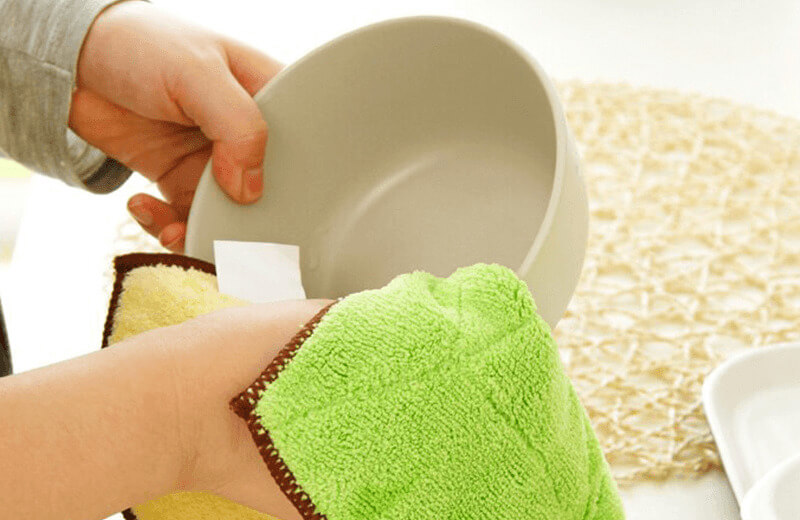
How it is used matters more, and this is the part almost no marketing mentions. A hospital tier disinfectant applied to a surface that has not been cleaned does not deliver its tier. The CDC is explicit that you must “clean the surface with soap and water first”, because “impurities like dirt may make it harder for sanitizing or disinfecting chemicals to kill germs”.
Contact time is the second half of it. Every registered disinfectant has a dwell time on its label, the period the surface must remain visibly wet for the claimed kill to occur. Spraying and immediately wiping is the single most common way a household or a rushed crew forfeits the efficacy it paid for. A cheaper disinfectant left wet for its full dwell time on a clean surface outperforms an expensive one wiped off after ten seconds.
When does a normal home actually need disinfection?
Less often than the cleaning industry implies, and the honest answer is a short list of situations rather than a routine. The CDC’s guidance is that regular cleaning is generally sufficient, and that disinfection belongs in areas where people have obviously been ill.
Four situations genuinely warrant it. Someone in the household has a vomiting or diarrhoeal illness, where the CDC recommends a chlorine bleach solution of 1,000 to 5,000 parts per million left in place for at least five minutes. Someone is immunocompromised, whether through chemotherapy, transplant medication, or another condition. Raw meat or poultry has contaminated a food preparation surface. Or a new household is moving into a home previously occupied by strangers. Outside those, routine cleaning of high-touch points is the proportionate response, and the guide to cleaning after a household illness covers the first case in detail.
Does a household with an immunocompromised member need more than this?
It often does, but the decision belongs with a clinician rather than a cleaning company. Nothing in this guide is medical advice. What a household in that position can reasonably ask a cleaning company for is a documented sequence: clean first, disinfect the agreed high-touch surfaces second, observe the dwell time, and avoid cross-contaminating between rooms.
The practical mechanics for those households, including scheduling around treatment cycles, are covered in house cleaning for immune-compromised homes in Fort Worth. Anyone in active treatment should confirm their own requirements with their care team before instructing any service.
What does Maid Brigade of Greater Fort Worth do differently?
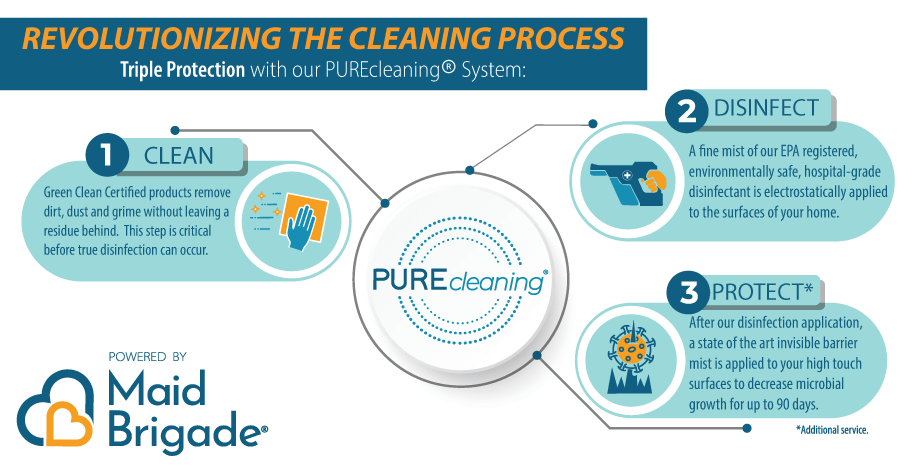
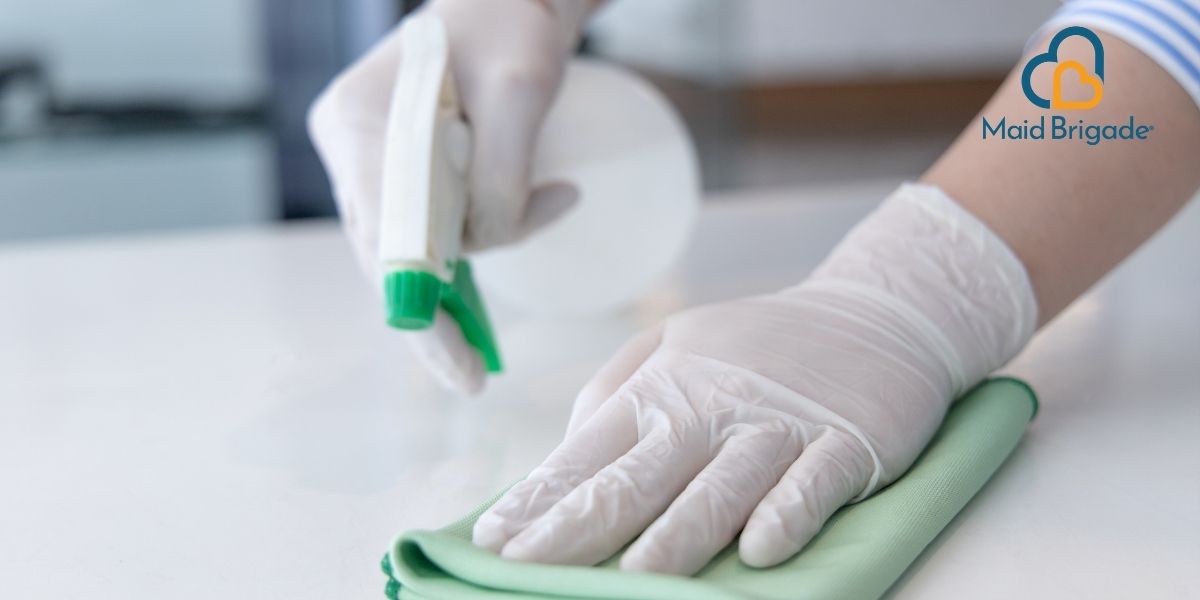
Maid Brigade of Greater Fort Worth describes the electrolyzed water it uses as a hospital grade disinfectant, and states that its agents are made on site from salt, water, and electricity, producing hypochlorous acid for light cleaning and disinfection and sodium hydroxide for general-purpose cleaning. Those are the company’s own published descriptions, reproduced here as company claims rather than as independently verified findings.
Two operational details do more work than the phrase itself. Crews follow a clean-first sequence rather than spraying disinfectant onto soiled surfaces, and they use a multi-fiber cloth system intended to prevent cross-contamination between rooms, which is the mechanism that stops a bathroom cloth reaching a kitchen counter. The company also states that its products are refreshed daily, which matters because hypochlorous acid loses potency in storage. If disinfection is the reason you are hiring, request a free, no-obligation quote and ask which surfaces would be disinfected and for how long they stay wet.
How do Fort Worth homeowners actually decide?
Most people do not need to decide this at all, which is the most useful thing to say plainly. If nobody in the house is ill or immunocompromised, the choice between cleaning services should turn on reliability, scope, trust, and price rather than on disinfectant tiers.
For the households where it does matter, three questions cut through the marketing. Which specific surfaces get disinfected, as opposed to cleaned? How long does the product stay wet on those surfaces? And is the hospital grade claim about a registered product with a registration number, or about a chemistry class supported by published research? Any company can answer those. A company that answers with adjectives instead of surfaces and durations is selling the word rather than the practice. For the wider vetting sequence, see what to ask before hiring a house cleaning company in Fort Worth, and for the honest limits of green chemistry, can eco-friendly cleaning actually disinfect and kill germs.
Key Takeaways
- The EPA defines a hospital disinfectant as a broad-spectrum disinfectant that is also effective against Pseudomonas aeruginosa, demonstrated through submitted efficacy data.
- The three registered tiers run limited, general or broad-spectrum, and hospital, with each step requiring more evidence.
- Equipment that generates a substance on site is a device, and the EPA states that devices are not registered and that an establishment number implies no review of safety or efficacy.
- A disinfectant applied to an uncleaned surface, or wiped off before its dwell time, does not deliver its tier no matter what the label says.
- The CDC’s position is that in most situations regular cleaning is enough, with disinfection reserved for areas where people have obviously been ill.
- The useful questions for a homeowner are which surfaces get disinfected, how long they stay wet, and whether the claim refers to a registered product or a chemistry class.
FAQ
Is hospital grade the strongest disinfectant available?
It is the highest of the three EPA registration tiers for disinfectants, but it is not the strongest antimicrobial category that exists. Sterilants and high-level disinfectants used on medical instruments are stronger still, and the CDC states these should never be used on environmental surfaces. For household surfaces, hospital grade is the top of the relevant ladder, defined by demonstrated efficacy against Pseudomonas aeruginosa in addition to broad-spectrum bacterial efficacy.
Does hospital grade mean it kills viruses?
Not automatically. The tier definitions are built on bacterial efficacy, specifically Staphylococcus aureus, Salmonella enterica, and Pseudomonas aeruginosa. Virus claims are separate and appear individually on a registered label, which is why products list named viruses rather than claiming viruses generally. If a specific virus matters to you, such as norovirus, look for that organism named on the label rather than relying on the tier.
How long does a disinfectant need to stay wet?
It depends entirely on the product, and the required period is printed on the label as the contact or dwell time. The CDC recommends leaving a bleach solution on a norovirus-contaminated area for at least five minutes. The common failure is spraying and wiping immediately, which forfeits the claimed efficacy. If you are hiring a cleaning company for disinfection specifically, ask what the dwell time is and whether crews actually observe it.
Do I need hospital grade disinfectant in a normal house?
Usually not. The CDC states that in most situations cleaning regularly is enough to prevent the spread of germs, and recommends disinfection for areas where people have obviously been ill. The situations that genuinely warrant it are a household illness involving vomiting or diarrhoea, an immunocompromised household member, raw meat contamination in a kitchen, or moving into a home previously occupied by strangers.
Can a company claim hospital grade without EPA registration?
In practice this happens frequently, because equipment that generates a disinfectant on site is regulated as a device rather than as a registered pesticide product, and the EPA does not require registration of devices. That does not make the chemistry ineffective, since hypochlorous acid has peer-reviewed support. It does mean you should read the phrase as describing a chemistry class rather than as certifying the specific liquid, and ask what evidence the company is actually relying on.
Should I ask for disinfection on every visit?
For most households, no. Routine disinfection of every surface is neither necessary nor free of tradeoffs, since it uses more chemistry in the home for little measurable benefit when nobody is ill. A more proportionate arrangement is routine cleaning with disinfection of high-touch points, and a documented escalation when someone in the house is sick. Agree that escalation in advance so it can be requested without renegotiating scope.
Bottom Line
Hospital grade is a genuine EPA efficacy tier meaning broad-spectrum plus demonstrated efficacy against Pseudomonas aeruginosa, and it is frequently used loosely because on-site generating equipment is a device rather than a registered product. The tier is also much less important than how the product is used, since a disinfectant on a dirty surface or wiped off early delivers nothing. Ask which surfaces, for how long, and on what evidence. To get those answers for your own home, book a visit or contact the office.
Sources
- What is electrolyzed water cleaning and how does it actually work for the chemistry behind on-site generated disinfectant.
- What is PUREcleaning and how does Maid Brigade make its cleaning agents on site for how a device-based system works in practice.
- Cleaning after a household illness for the situation that genuinely calls for disinfection.
- House cleaning for immune-compromised homes in Fort Worth for households where the threshold is different.
- Can eco-friendly cleaning actually disinfect and kill germs for the honest limits of green chemistry.
- What to ask before hiring a house cleaning company in Fort Worth for the wider vetting sequence.
- United States Environmental Protection Agency, antimicrobial product registration guidance: the definitions of limited, general, and hospital disinfectants.
- United States Environmental Protection Agency, pesticide devices guide for consumers: devices are not registered, and an establishment number implies no review of safety or efficacy.
- Centers for Disease Control and Prevention, when and how to clean and disinfect: cleaning before disinfecting, and when routine cleaning is sufficient.
- Centers for Disease Control and Prevention, norovirus prevention: the bleach concentration and five-minute dwell time for a contaminated area.
- EWASH trial, National Library of Medicine: the peer-reviewed comparison of hypochlorous acid against sodium hypochlorite.