
House Cleaning for Immune-Compromised Homes in Fort Worth: Low-Tox Cleaning During Chemo or Illness
By Maid Brigade of Greater Fort Worth, serving Fort Worth and the Mid-Cities since 1989. Editorial verification September 10, 2026.
Last updated: 2026-09-10
Verified against the American Cancer Society and the Asthma and Allergy Foundation of America on September 10, 2026. Every external link in this guide was checked live during that review and the cited pages re-read where they permit automated access; dead citations found in that sweep were replaced or removed. Desk verification of published sources is the method used, and no laboratory or in-home testing was performed for this guide.
TL;DR: When someone in the home is going through chemotherapy or living with a weakened immune system, focus a cleaning routine on what a cleaning service can honestly control: keeping high-touch surfaces clean, reducing dust and buildup, and using lower-fume products applied by a crew you have vetted. Clinical infection-prevention decisions belong to the oncology or care team. This guide is general information, not medical advice.
The house becomes a source of anxiety in a way it never was before. Someone mentions germs on doorknobs and suddenly every surface feels like a question you are not qualified to answer, at exactly the moment the household has the least energy to research anything. Meanwhile the person who normally cleans is either the one in treatment or the one managing appointments, medications, and everything else. The useful thing to know first is that the guidance here is more specific and more manageable than it feels. The American Cancer Society’s advice concentrates on a short list of frequently touched items including phones, tablets, remote controls, doorknobs, and light switches, cleaned with regular soap and water or household disinfecting wipes. That is a list, not an ordeal.
How should you clean a house for someone going through chemo or with a weak immune system?
Concentrate on three things a cleaning routine can genuinely deliver: keep high-touch surfaces clean, reduce accumulated dust and buildup, and limit exposure to harsh fumes and strong fragrances. Beyond that, hand clinical questions to the care team, because decisions about what level of infection precaution a specific patient needs are medical decisions that depend on treatment type, blood counts, and individual circumstances.
That division is the important part. A cleaning company can clean a house well and reduce the household labor burden at a moment when it is crushing. It cannot assess infection risk, and any company that offers to is going beyond what it can know.
Why does infection risk rise during treatment?
Because many cancer treatments suppress the immune system as a side effect, which reduces the body’s ability to fight off infections it would otherwise handle. This is why home hygiene guidance changes during treatment when it would be unremarkable at any other time.
“For people with cancer undergoing treatment, many are at increased risk for infections due to their weakened immune system,” says Richard T. Lee, MD, an American Society of Clinical Oncology expert and the Cherng Family Director’s Chair at City of Hope.
The practical consequence for a household is that ordinary cleaning becomes worth doing deliberately rather than casually, with attention to the surfaces that see the most hand contact. It does not mean the home needs to become a clinical environment, and the guidance from major cancer organizations is notably proportionate. Your care team will tell you if your situation calls for more than the general guidance.
Which surfaces actually matter most?
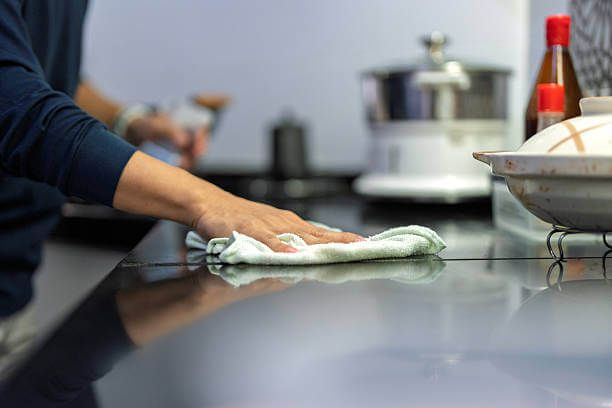
High-touch surfaces, meaning the things hands contact many times a day. The American Cancer Society’s guidance names phones, tablets, remote controls, doorknobs, and light switches specifically, and recommends regular soap and water or household disinfecting wipes rather than anything exotic.
| Priority | Surfaces | Why it matters | Typical approach |
|---|---|---|---|
| Highest | Doorknobs, light switches, faucet handles, remotes, phones, tablets | Highest frequency of hand contact in any home | Soap and water or household disinfecting wipes, frequently |
| High | Bathroom fixtures, toilet handles, counters | High contact plus moisture | Regular cleaning as part of every visit |
| High | Kitchen surfaces and handles | Food preparation and constant contact | Washed before and after food preparation |
| Moderate | Floors, soft furnishings, general dust | Dust accumulation the ACS advises keeping down | Regular vacuuming and damp dusting |
| Situational | Laundry with body fluids | Specific handling guidance during chemotherapy | Follow your care team’s instructions |
The American Cancer Society also advises trying to keep the house dust free. On dust specifically, the Asthma and Allergy Foundation of America recommends vacuuming once or twice a week and using a damp or treated cloth for dusting so particles are captured rather than pushed into the air.
What should you ask a cleaning company when someone is immunocompromised?
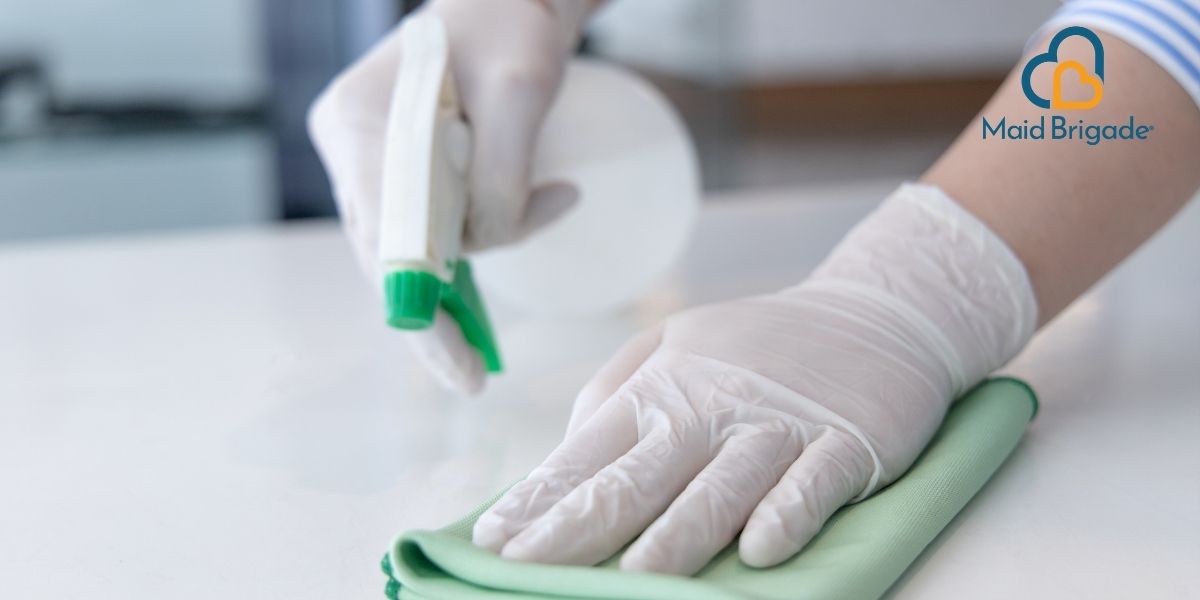
Ask what products are used, whether anything scented is applied or left behind, whether high-touch surfaces are part of the standard scope, and whether your instructions can be recorded on the work order. Then ask how crews are screened, since a household in this situation has a stronger than usual interest in who enters.
The scent question deserves emphasis. Someone in treatment may have heightened sensitivity to smells, and nausea is a common side effect that strong fragrance can worsen. Allergists have separately flagged home fragrance products as a respiratory concern. In figures presented to the American College of Allergy, Asthma and Immunology in 2011, about 20 percent of the population and 34 percent of people with asthma reported health problems from air fresheners. Ask specifically whether any scented finishing product is used at the end of a visit, because that is the most common unwelcome surprise. Get the answer in writing on the work order, so it survives a crew change rather than depending on who arrives. What to ask before hiring a house cleaning company covers the broader vetting sequence.
Should the person in treatment be home during the cleaning?
Most households arrange for them to be elsewhere during the visit and for a short period afterward, which allows ventilation and avoids exposure to dust stirred up during cleaning. This is a practical preference rather than a medical instruction, and your care team is the right source if you need a definite answer for your situation.
The reasoning is straightforward: cleaning temporarily increases airborne dust, and the Asthma and Allergy Foundation of America notes that people with allergies are often advised to leave the home for several hours after housework for exactly this reason. If leaving is not practical, keeping the person in a room that is cleaned first, then closed, is the common workaround. Ventilating afterward helps in either case. Households managing this alongside limited mobility will find related planning in house cleaning for limited mobility and chronic illness.
How often should the home be cleaned during treatment?
Most households benefit from a deep clean at the start of treatment followed by weekly recurring visits, though the right answer depends on the household rather than a rule. The deep clean handles accumulated buildup that nobody has had capacity to address, and weekly visits keep high-touch surfaces and dust under control without requiring anyone to plan it.
Weekly rather than biweekly is the common choice here for the same reason it is in other high-need households: the in-between maintenance that biweekly assumes is exactly what a household under this kind of strain cannot reliably provide. Treatment schedules also make predictability valuable, so a fixed day that works around infusion or appointment days is worth setting up deliberately. The timing logic is similar to house cleaning before and after surgery, which covers how to sequence visits around a medical calendar. The scope of a first reset is set out under deep cleaning.
What does Maid Brigade of Fort Worth publish about crews and products?
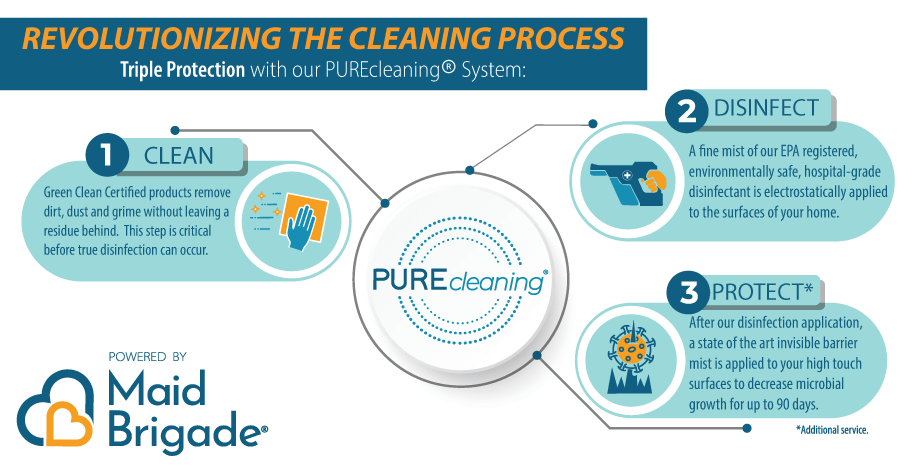
On crews, Maid Brigade of Greater Fort Worth states that all of its cleaning professionals are thoroughly trained and undergo comprehensive criminal background checks before being hired, and that the company provides liability and workers’ compensation insurance. Crews arrive fully equipped, so a household under treatment never has to buy, store, or handle cleaning chemicals. The company also uses a multi-fiber cloth system intended to prevent cross-contamination between areas of the home.
On products, the company describes its PUREcleaning service and products as environmentally friendly, non-toxic, non-irritant and safe for you, your family and pets, states that its cleaning agents are free from harsh odors, and describes electrolyzed water as a hospital-grade disinfectant. The agents are made on site from salt, water, and electricity, producing hypochlorous acid for light cleaning and disinfection and sodium hydroxide for general-purpose cleaning, made in house and refreshed daily.
Those are the company’s own published descriptions, and this guide presents them as such rather than as clinical findings. Nothing in them constitutes a medical claim about infection prevention for an immunocompromised person, and it would be wrong to read them that way. What they do offer a household in this position is a specific, named chemistry that can be researched independently, and low-odor routine cleaning at a time when strong smells are unwelcome. Maid Brigade has been family-owned and serving the Fort Worth and Mid-Cities area since 1989, with a 100% Satisfaction Guarantee. Raise your specific requirements when you request a free quote so they are recorded before the first visit.
How do Fort Worth households manage this alongside treatment?
The households that manage it best decide once and then stop deciding. Across Fort Worth, Hurst, Bedford, and North Richland Hills, the common pattern is a deep clean scheduled in the week before treatment starts, a fixed weekly slot chosen to avoid infusion days, and entry arranged by keypad or lockbox so nobody answers the door on a bad day.
Three details come up repeatedly. The first is a written instruction sheet on the work order covering products, scent, which rooms are off limits, and whether to knock or ring. The second is designating one room as the low-disturbance space, cleaned first and then left alone, which gives the person in treatment somewhere predictable to be. The third is accepting help earlier than feels necessary, because the households that struggle most are usually the ones that waited until they were already overwhelmed to arrange anything. If a family member is coordinating this from a distance, setting it up on their own account and arranging billing separately removes one more task from the person in treatment. Related planning for older adults living independently is covered in house cleaning for seniors aging in place.
To set products, scent, and access details before the first visit, request a free quote and ask for everything to go on the work order.
Agree the precautions with your care team first, then contact the office to have them recorded on the work order so they survive a crew change.
Key Takeaways
- A cleaning routine during treatment should focus on what a service can honestly control: high-touch surfaces, dust reduction, and lower-fume products applied by a vetted crew.
- The American Cancer Society’s home guidance centers on frequently touched items such as phones, tablets, remote controls, doorknobs, and light switches, cleaned with soap and water or household disinfecting wipes.
- Clinical infection-prevention decisions belong to the oncology or care team, and no cleaning company can assess what precautions a specific patient needs.
- Ask explicitly whether any scented finishing product is used at the end of a visit, since nausea and scent sensitivity are common during treatment.
- Weekly visits after an initial deep clean suit most households, because the in-between maintenance biweekly assumes is exactly what a strained household cannot reliably provide.
- Put product, scent, and access instructions in writing on the work order so they survive crew changes rather than depending on who arrives.
FAQ
Is it safe to have my house professionally cleaned during chemotherapy?
Many households do arrange professional cleaning during treatment, and reducing the household labor burden is often valuable at that time. Whether it is appropriate for your situation, and what precautions apply, are questions for your oncology team rather than a cleaning company, because the answer depends on your treatment, your blood counts, and your individual circumstances. What you can control is vetting the company thoroughly, specifying products and scent preferences in writing, and arranging for the person in treatment to be elsewhere during the visit if that is practical.
Which surfaces should be prioritized when someone is immunocompromised?
High-touch surfaces come first. The American Cancer Society names phones, tablets, remote controls, doorknobs, and light switches specifically, and recommends cleaning them regularly with soap and water or household disinfecting wipes. Bathroom fixtures, faucet handles, and kitchen surfaces follow closely, since they combine frequent contact with moisture or food preparation. The ACS also advises keeping the house dust free, which is where regular vacuuming and damp dusting fit in.
Should someone in treatment leave the house during a cleaning?
Many households arrange it that way, because cleaning temporarily increases airborne dust and allergy organizations commonly advise sensitive individuals to be away for several hours after housework. It is a practical preference rather than a medical instruction, so ask your care team if you need a definite answer. If leaving is not workable, a common approach is cleaning one room first, closing it, and having the person stay there, then ventilating the rest of the home afterward.
What should I tell a cleaning company about our situation?
Tell them what you need operationally rather than sharing medical detail you would rather keep private. That means specifying which products are acceptable, that no scented finishing product should be used or left behind, that high-touch surfaces are a priority, which rooms are off limits or should be cleaned first, and how the crew should approach the door. Ask for all of it to be recorded on the work order rather than explained to whoever arrives, so the instructions survive a crew change.
How often should the house be cleaned during treatment?
A deep clean at the start of treatment followed by weekly recurring visits suits most households, though the right cadence depends on the home and the household. Weekly is generally chosen over biweekly because biweekly assumes someone is handling basic maintenance in between, which is exactly the capacity a household under treatment tends not to have. Setting a fixed day that avoids infusion or appointment days makes the schedule predictable at a time when little else is.
Can a cleaning company disinfect a home for someone with a weak immune system?
A cleaning company can clean thoroughly and can use disinfecting products on surfaces, but it cannot make medical guarantees about infection risk, and you should be cautious of any company that implies otherwise. Product descriptions, including terms like hospital-grade, are manufacturer or company descriptions rather than clinical assurances for a specific household. Ask what is used, research it if you want to, and take clinical questions about what level of precaution you need to your care team.
Maid Brigade of Greater Fort Worth verified the high-touch surface guidance and the quotation from Dr. Richard T. Lee against the American Cancer Society, the vacuuming and dusting guidance against the Asthma and Allergy Foundation of America, and the 2011 air freshener figures against the November 2011 reporting of the American College of Allergy, Asthma and Immunology findings, on August 24, 2026. All product and service descriptions are Maid Brigade of Greater Fort Worth’s own published wording as of that date and are not clinical claims. This guide is general information about cleaning, not medical advice. Follow your oncology or care team’s instructions.
Sources
- House cleaning before and after surgery in the Mid-Cities for sequencing visits around a medical calendar.
- House cleaning for limited mobility and chronic illness in Fort Worth for related household planning.
- House cleaning for seniors aging in place in Fort Worth for older adults living independently.
- What to ask before hiring a house cleaning company in Fort Worth for the vetting sequence.
- American Cancer Society, how to keep your home clean when living with cancer: high-touch surface guidance, cleaning methods, and the quotation from Dr. Richard T. Lee of City of Hope.
- Asthma and Allergy Foundation of America, Control Indoor Allergens: vacuuming frequency, damp-cloth dusting, and guidance on leaving the home after housework.
- Medical News Today, reporting on American College of Allergy, Asthma and Immunology findings: the figures on air fresheners and reported health problems.