
Can Eco-Friendly Cleaning Actually Disinfect and Kill Germs? The Honest Answer
By Maid Brigade of Greater Fort Worth, serving Fort Worth and the Mid-Cities since 1989. Editorial verification September 10, 2026.
Last updated: 2026-09-10
Verified against the Centers for Disease Control and Prevention, the United States Environmental Protection Agency, and peer-reviewed research indexed in PubMed on September 10, 2026. Every external link in this guide was checked live during that review and the cited pages re-read where they permit automated access; dead citations found in that sweep were replaced or removed. Desk verification of published sources is the method used, and no laboratory or in-home testing was performed for this guide.
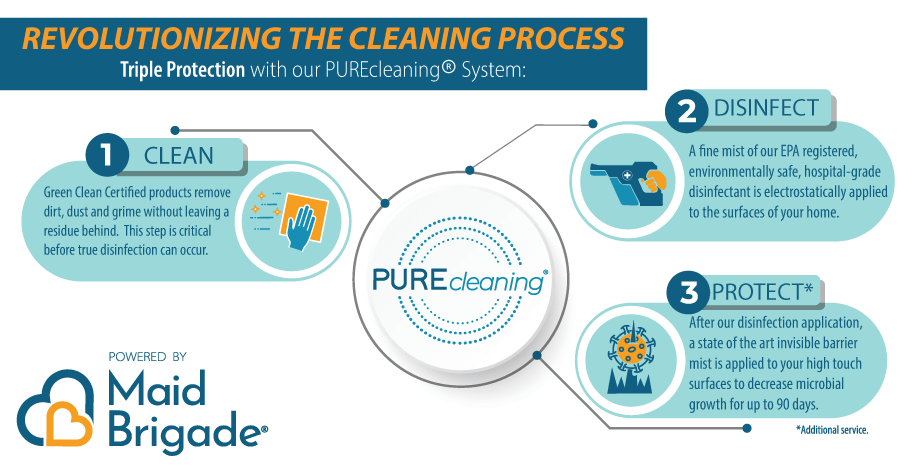
TL;DR: Yes, eco-friendly cleaning can kill germs, but only when the job uses an EPA-registered disinfectant kept wet for its full label dwell time, because green and germ-killing are not opposites. An eco-certification speaks to ingredient safety around kids and pets, while EPA registration is the separate proof that a product kills named viruses and bacteria. Maid Brigade of Greater Fort Worth cleans with PUREcleaning products chosen to be safer around kids and pets, and for germ-heavy needs the crew applies EPA-registered disinfectants at their full dwell time on high-touch surfaces during a Deep Clean.
Going green does not have to mean giving up real germ control. The confusion comes from mixing two different jobs and two different labels. This guide separates cleaning from disinfecting, explains what an eco-certification proves and what it does not, and shows how a green-minded crew still kills germs on the surfaces that matter across Fort Worth and the Mid-Cities.
Can eco-friendly cleaning actually disinfect and kill germs?
Yes, eco-friendly cleaning can disinfect and kill germs, but the result depends on the product’s regulatory status and the technique, not on a harsh chemical smell. Cleaning with a green product removes soil and lowers germ counts by wiping them away. Killing germs requires an EPA-registered disinfectant left wet for its full label time. Green and germ-killing are not opposites.
The EPA’s Design for the Environment (DfE) program makes the point directly: when a consumer or purchaser sees the DfE logo on a product, they can feel confident that the product meets stringent EPA criteria for efficacy and effects on human health and the environment. In plain terms, a single product can be both an effective disinfectant and a safer formulation. The label word “green” is not the deciding factor. The regulatory status and how the product is used are what determine whether germs actually die.
What is the difference between cleaning, sanitizing, and disinfecting?
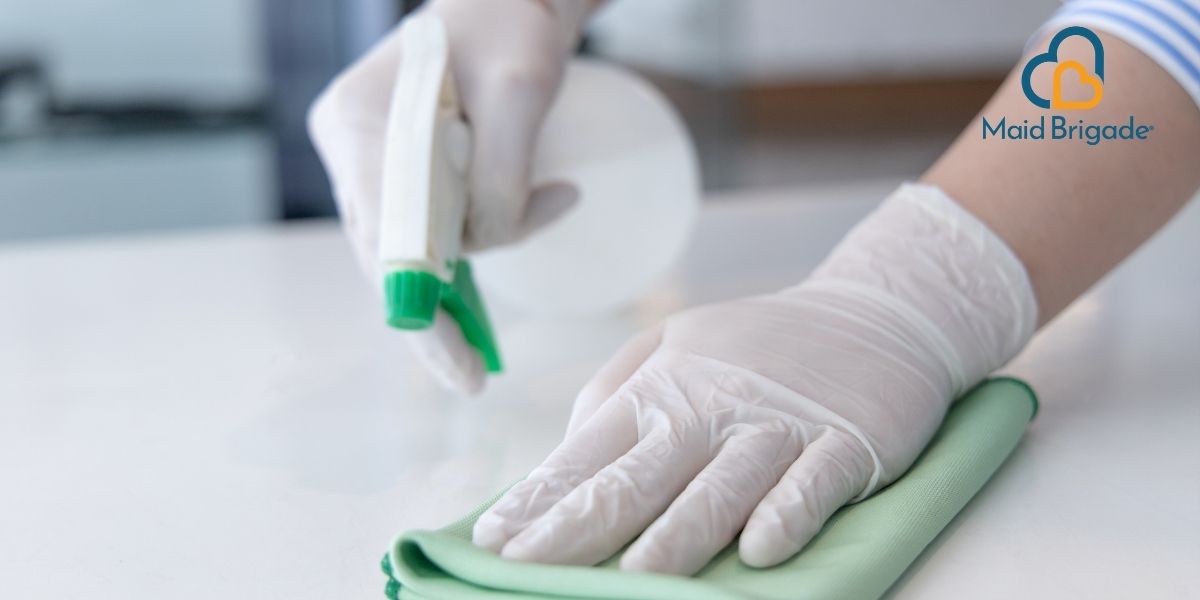
Cleaning, sanitizing, and disinfecting are three distinct steps, not synonyms. Cleaning physically removes germs, dirt, and impurities from a surface with soap, water, and scrubbing. Sanitizing lowers germs to a level public health codes consider safe. Disinfecting kills the germs that remain, and it requires a chemical registered for that purpose.
According to the CDC, cleaning removes germs and dirt from surfaces while disinfecting uses chemicals to kill remaining germs, and the agency advises cleaning a surface before disinfecting it because dirt can make it harder for the chemical to work. The CDC also notes that routine disinfecting at home is likely not needed unless someone is sick or a sick person has recently visited.
| Step | What it does | What it needs |
|---|---|---|
| Cleaning | Removes germs, dirt, and soil from a surface | Soap or detergent, water, and scrubbing |
| Sanitizing | Lowers germs to a level considered safe | A sanitizing product used per label |
| Disinfecting | Kills the germs that remain on a surface | An EPA-registered disinfectant kept wet for its full dwell time |
Eco-certified vs EPA-registered: which label proves a product kills germs?
EPA registration proves a product kills germs; an eco-certification does not. The two labels answer two different questions. An eco-certification such as Green Seal speaks to ingredient safety and being chosen to be safer around kids and pets. An EPA registration is the proof that a product kills named viruses and bacteria when used as directed.
That distinction is why the EPA runs two related but separate programs. Its Safer Choice label, which nearly 2,000 products currently qualify to carry, recognizes everyday products that meet ingredient-safety criteria, while the pesticide side of the same program, Design for the Environment, certifies disinfectants and sanitizers that also pass EPA efficacy review. Announcing the modernized DfE logo for disinfectants, Michal Freedhoff, EPA Assistant Administrator for the Office of Chemical Safety and Pollution Prevention, said, “Protecting the health and safety of our families and our homes is central to EPA’s mission.” A product can carry an ingredient-safety label, an efficacy registration, or both, so the honest move is to name which label applies to which task.
| Question | Eco-certification | EPA registration |
|---|---|---|
| What it proves | Ingredients chosen to be safer around kids and pets | The product kills named viruses and bacteria |
| What it does not prove | That the product kills a specific germ | That every ingredient is low-hazard |
| Where you see it | Product label and manufacturer certification | EPA registration number on the label |
Labels are also where green claims are most often overstated. How to vet a green cleaning company and avoid greenwashing gives the three questions that separate a verifiable claim from a marketing one.
Do green disinfectants kill viruses and bacteria as well as bleach?
Yes, many green disinfectants kill viruses and bacteria as effectively as bleach, because the EPA judges a disinfectant by its tested performance, not by its active ingredient. Many EPA-registered disinfectants rely on active ingredients such as hydrogen peroxide, citric acid, lactic acid, or thymol rather than bleach or quaternary ammonium. A 2017 peer-reviewed study published in the Journal of Food Science found that a 0.5 percent hydrogen peroxide formulation achieved at least a 99.99 percent (4-log) reduction in E. coli, Staphylococcus aureus, and two other bacteria strains on stainless steel surfaces, the same order of kill regulators expect from bleach-based products.
The EPA defines a disinfectant as a product that destroys or irreversibly inactivates bacteria, fungi, and viruses on a surface. Whether the active ingredient is bleach or a plant-derived acid, the registration number is the signal that the product passed that testing. The smell of the chemical says nothing about the result.
Why does dwell time, not a harsh smell, decide whether germs die?
Dwell time decides whether germs die, because a disinfectant only works while the surface stays wet for the full time printed on its label. Dwell time is also called contact time or wet time. If the surface dries before the label’s contact time is up, germs can survive no matter how strong the product smelled.
The EPA is specific about this: the surface should be visibly wet for the entire contact time, and if a product lists a 10-minute contact time, the surface should remain visibly wet for at least 10 minutes after it is applied. That is why a quick spray-and-wipe cleans but does not reliably disinfect. The strong odor of a conventional cleaner is a separate issue for indoor air. The American Lung Association reports that VOCs and other chemicals released when using cleaning supplies contribute to chronic respiratory problems, allergic reactions, and headaches, and cautions that even products advertised as green or natural may contain ingredients that can cause health problems. That trade-off matters in North Texas, where many Fort Worth and Mid-Cities households already work to keep airborne irritants down during cedar fever and oak-pollen season.
Which surfaces in a Fort Worth or Mid-Cities home actually need disinfecting?
The surfaces that need disinfecting are the high-touch ones that many hands share, especially during and after illness. That means kitchen counters, sinks, and faucet handles, plus doorknobs, light switches, toilet handles, and bathroom fixtures. Most other surfaces only need regular cleaning.
The CDC flags high-touch surfaces for extra attention when someone is sick and notes that routine home disinfection is likely not needed unless someone is ill or a sick person has recently visited. For a Mid-Cities family, that usually means everyday cleaning most weeks, with targeted disinfection during flu season or after a household illness. When a home needs that kind of reset after a holiday or a house full of guests, a post-hosting reset clean for your Fort Worth home covers the same high-touch surfaces.
How does Maid Brigade clean and disinfect while staying safer around kids and pets?
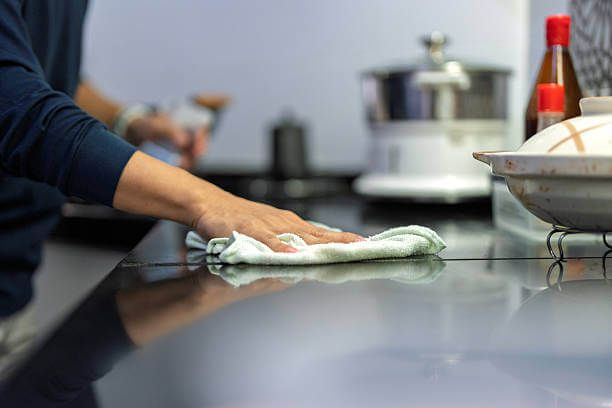
Maid Brigade of Greater Fort Worth cleans with PUREcleaning products chosen to be safer around kids and pets, and for germ-heavy needs the crew applies EPA-registered disinfectants at their full dwell time on high-touch surfaces during a Deep Clean. Cleaning comes first, then targeted disinfection, which follows the sequence the CDC recommends.
Because the team arrives fully equipped, clients across Fort Worth, Hurst, Euless, Bedford, Colleyville, North Richland Hills, Keller, Southlake, Grapevine, Watauga, and Haltom City never buy, mix, or store any product. Households that want to understand which ingredients are gentle around animals can read which house cleaning products are actually pet-safe around dogs and cats. The crews are trained, background-checked, and covered by liability and workers’ compensation insurance, and the company has been locally owned and family-operated in the area since 1989. You can compare what each visit includes on the services page. One of the specific tools behind that eco-friendly, disinfecting combination is electrolyzed water; is electrolyzed water cleaning safe for kids and pets explains the mechanism and the safety evidence behind it.
When should you book a Deep Clean instead of a Standard Clean?
Book a Deep Clean when the goal is germ control after illness, a seasonal reset, or a first professional visit, because a Deep Clean is the service that includes disinfecting high-touch surfaces with EPA-registered products used for their full dwell time. A Standard Clean maintains an already clean home on a recurring schedule and does not focus on germ-heavy reset work.
Only three services exist: Standard Clean, Deep Clean, and Move Clean, and disinfection lives inside the Deep Clean rather than as a separate add-on. Households that want to hold the result move to recurring cleaning after the first Deep Clean. If price is part of the decision, the Fort Worth house cleaning cost guide explains what moves a quote up or down. When you are ready, request a free quote or book your first cleaning.
Key Takeaways
- Eco-friendly cleaning can kill germs, but only when an EPA-registered disinfectant is left visibly wet for its full label dwell time.
- Cleaning removes germs and soil, sanitizing lowers germs to a safe level, and disinfecting kills the germs that remain, which the CDC treats as three distinct steps.
- An eco-certification proves ingredient safety, while an EPA registration is the separate proof that a product kills named viruses and bacteria.
- Many EPA-registered disinfectants use hydrogen peroxide, citric acid, or thymol instead of bleach, so a harsh smell is not a sign of effectiveness.
- A 2017 peer-reviewed study found a 0.5 percent hydrogen peroxide formulation reached at least a 99.99 percent (4-log) reduction in common bacteria, showing plant- and peroxide-based actives can match bleach-level results.
- Nearly 2,000 products currently qualify to carry the EPA’s Safer Choice label, which is the ingredient-safety program eco-certifications like PUREcleaning sit alongside.
- The CDC advises cleaning a surface before disinfecting it and notes routine home disinfection is likely not needed unless someone is sick.
- Maid Brigade of Greater Fort Worth cleans with PUREcleaning products and, for germ-heavy needs, applies EPA-registered disinfectants at full dwell time on high-touch surfaces during a Deep Clean.
FAQ
Can green cleaning products really kill germs, or do you need bleach?
Green cleaning products can kill germs when the product carries an EPA registration and is used for its full label dwell time, so you do not need bleach specifically. The EPA judges a disinfectant by tested performance, and many registered disinfectants use hydrogen peroxide, citric acid, or thymol instead of bleach. A plain green cleaner with no EPA registration cleans and lowers germ counts but should not be called a disinfectant.
What is the difference between an eco-certified product and an EPA-registered disinfectant?
An eco-certification speaks to ingredient safety, meaning the product was chosen to be safer around kids and pets. An EPA registration is a separate approval that proves the product kills named viruses and bacteria when used as directed. A product can hold one label, the other, or both, so the labels answer two different questions.
Are the products Maid Brigade uses safe around kids and pets?
Maid Brigade of Greater Fort Worth cleans with PUREcleaning products chosen to be safer around kids and pets. When a job calls for disinfection, the crew uses EPA-registered disinfectants according to their label directions. Because the team arrives fully equipped, families never buy, mix, or store any cleaning product at home.
How long does a disinfectant need to stay wet on a surface to actually work?
A disinfectant needs to stay visibly wet for the full contact time printed on its label, which is often several minutes. The EPA states that if a label lists a 10-minute contact time, the surface should remain visibly wet for at least 10 minutes. If the surface dries first, germs can survive, which is why a fast spray-and-wipe does not reliably disinfect.
Does Maid Brigade of Fort Worth disinfect high-touch surfaces, and during which service?
Yes, Maid Brigade of Greater Fort Worth disinfects high-touch surfaces such as counters, faucet handles, doorknobs, light switches, and bathroom fixtures using EPA-registered products kept wet for their full dwell time. That disinfection is part of the Deep Clean rather than a separate service. Cleaning happens first, then targeted disinfection, which follows CDC guidance.
Should I book a Deep Clean or a Standard Clean after someone in my house has been sick?
Book a Deep Clean after an illness, because it includes disinfecting high-touch surfaces with EPA-registered products used for their full dwell time. A Standard Clean is designed to maintain an already clean home on a recurring schedule and does not focus on germ-heavy reset work. Many Fort Worth households start with a Deep Clean and then move to a recurring plan to hold the result.
Sources
- Maid Brigade of Fort Worth: deep cleaning
- Maid Brigade of Fort Worth: recurring cleaning
- Maid Brigade of Fort Worth: cleaning services
- Maid Brigade of Fort Worth: request a free quote
- Maid Brigade of Fort Worth: book a cleaning
- Post-hosting reset clean for your Fort Worth home
- Which house cleaning products are actually pet-safe
- How much does house cleaning cost in Fort Worth?
- CDC: Cleaning and Disinfecting
- EPA: Selected EPA-Registered Disinfectants
- EPA: Design for the Environment Logo for Antimicrobial Pesticide Products
- EPA: Modernized Design for the Environment logo for disinfectants
- EPA: Learn About the Safer Choice Label
- Ríos-Castillo et al., “Bactericidal Efficacy of Hydrogen Peroxide-Based Disinfectants,” Journal of Food Science, 2017
- American Lung Association: Cleaning Supplies and Household Chemicals