
Cleaning After a Household Illness: Flu, Norovirus, and Stomach Bugs in Fort Worth
By Maid Brigade of Greater Fort Worth, serving Fort Worth and the Mid-Cities since 1989. Editorial verification September 9, 2026.
Last updated: 2026-09-09
Verified against Centers for Disease Control and Prevention norovirus prevention guidance, CDC handwashing facts and statistics, and CDC guidance on when and how to clean and disinfect, on September 9, 2026. The Elizabeth Scott quotation was confirmed at the American Society for Microbiology page where it appears. Nothing here is medical advice; contact a clinician about symptoms, dehydration, or care decisions. Desk verification of published sources is the method used.
TL;DR: Most household disinfecting products do not kill norovirus, because it has no lipid envelope for alcohol to attack. The CDC recommends a chlorine bleach solution of 1,000 to 5,000 parts per million left in place for at least five minutes, laundry washed hot at maximum cycle length and dried on the highest heat, and food handling avoided for at least 48 hours after symptoms stop.
Three things make a stomach bug worse than it needs to be, and all three are avoidable. The house gets wiped down with the products already under the sink, most of which do nothing to this particular virus. The person who was ill returns to cooking as soon as they feel better, while still shedding. And everyone assumes hand sanitizer covers it, when the CDC’s own figures put handwashing’s effect on diarrhoeal illness at “23-40%”.
This guide covers why norovirus defeats ordinary products, the exact CDC sequence, laundry and soft surfaces, how long to keep it going, and when to bring in help.
What actually kills norovirus on household surfaces?
A chlorine bleach solution at sufficient concentration, left wet long enough, on a surface that has already been cleaned. The Centers for Disease Control and Prevention recommends “a chlorine bleach solution with a concentration of 1,000 to 5,000 ppm (5 to 25 tablespoons of household bleach [5% to 8%] per gallon of water)”, or an EPA-registered product listed as effective against norovirus specifically.
The dwell time is not optional. The CDC’s instruction is to “Leave bleach disinfectant on the affected area for at least 5 minutes”. Spraying and immediately wiping is the single most common way a household does all the work and gets none of the benefit.
Why do ordinary disinfecting wipes not work on it?
Because norovirus lacks the lipid envelope that alcohol and many common disinfectants are designed to disrupt. Enveloped viruses, including influenza and coronaviruses, are comparatively fragile: damage the fatty coat and the virus fails. Norovirus has no such coat, which is why it survives products that handle other pathogens easily.
It is also unusually robust physically. The CDC notes that “noroviruses are relatively resistant to heat and can survive temperatures as high as 145 F”, which is why a warm rinse achieves nothing. This is the specific reason a household can clean conscientiously with the wrong product and watch the illness move person to person anyway.
What is the correct order of operations?
Clean first, then disinfect, and never the reverse. The CDC is explicit that you should “clean the surface with soap and water first”, because “impurities like dirt may make it harder for sanitizing or disinfecting chemicals to kill germs”.
For a contamination event the CDC sequence is specific: wear gloves, wipe the area with paper towels and dispose of them, apply the disinfectant per the product instructions, allow the full dwell time, then clean the entire area again with soap and hot water. Note that cleaning appears twice, before and after. That is not redundancy, it is how the contamination is physically removed and then the surface is restored.

Which surfaces actually matter after someone has been sick?
The high-touch points and the bathroom, in that order, rather than every surface in the house. Elizabeth Scott, Ph.D., co-director and founder of the Simmons Center for Hygiene and Health in Home and Community, argues for targeted hygiene, an approach that “prevents the spread of harmful microbes in a targeted manner. It addresses sustainability issues, it avoids the overuse of chemicals and microbicides, it sustains exposure to beneficial microbes”.
| Priority | Surfaces | Why |
|---|---|---|
| Highest | Toilet, flush handle, toilet surround, bathroom door handle and light switch | Direct contamination route |
| Highest | Taps, sink, and any surface within reach of a vomiting event | Direct contamination route |
| High | Door handles, light switches, stair rails, fridge handle | Hand to surface to hand transfer |
| High | Phones, remotes, tablets, game controllers | Constantly touched, rarely cleaned |
| Medium | Kitchen counters and food preparation surfaces | Where a still-shedding person could contaminate food |
| Low | Floors, walls, general surfaces | Rarely the transmission route in a home |
Spraying the whole house is effort spent in the wrong place. Concentrating on the top four rows is what actually interrupts transmission.
How should laundry and soft surfaces be handled?
Hot, long, and dried on high, with no shaking. The CDC advises that contaminated items should be washed “with detergent and hot water at the maximum available cycle length and then machine dry them at the highest heat setting”.
Handle soiled laundry as little as possible and do not shake it out, since that aerosolizes particles into the room. Wear gloves, transfer items directly into the machine, and wash your hands afterwards. Soft furnishings that cannot go in a machine are the hardest part of this problem, because bleach is not usable on most fabrics. Steam or professional treatment is the practical route, and anything heavily contaminated may be more sensibly discarded.
How long should this continue after symptoms stop?
Longer than almost anyone expects, and this is where household transmission usually happens. The CDC states that norovirus “can stay in your poop for 2 weeks or more after you feel better”, and advises waiting “at least 2 days (48 hours) after symptoms stop” before preparing food for others or caring for someone.
Practically, that means the person who was ill stays out of food preparation for at least two full days after they feel fine, and rigorous handwashing continues for considerably longer. The CDC’s figures on handwashing put the reduction in diarrhoeal illness at 23 to 40 percent generally and “58%” among people with weakened immune systems, which is why hand hygiene rather than surface spraying is the highest-value habit in the weeks afterwards.
What about a household with someone immunocompromised?
The threshold changes and the decision belongs with a clinician, not a cleaning company. Nothing in this guide is medical advice. A household in that position should agree with their care team what precautions apply, then instruct any cleaning service accordingly rather than the other way round.
What a cleaning company can reasonably deliver is a documented sequence: clean first, disinfect the agreed high-touch surfaces, observe the dwell time, avoid cross-contaminating between rooms, and record it on the work order so it survives a crew change. The practical mechanics are covered in house cleaning for immune-compromised homes in Fort Worth, and the disinfection terminology in what does hospital grade disinfectant actually mean.
What does Maid Brigade of Greater Fort Worth do differently?
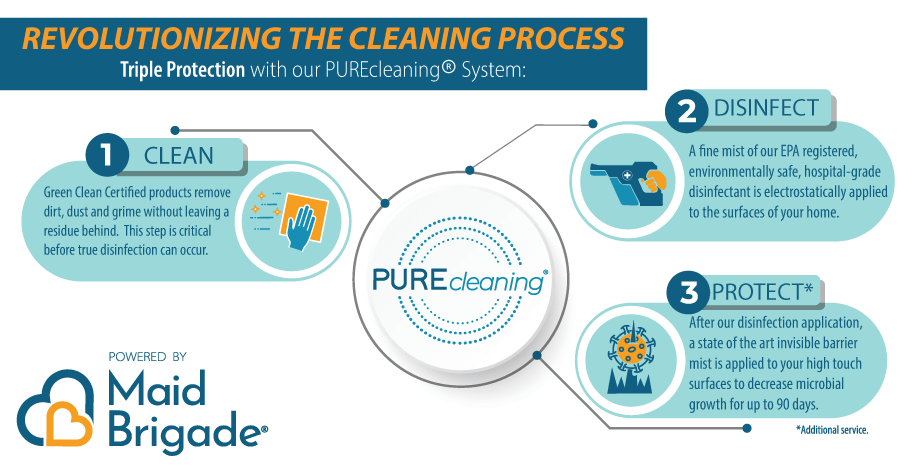
Maid Brigade of Greater Fort Worth works clean-first as standard rather than treating disinfection as a spray-and-go step, and its crews use a multi-fiber cloth system intended to prevent cross-contamination between rooms. That matters more during an illness than at any other time, because a single cloth moving from a bathroom to a kitchen is precisely the transmission route you are trying to close.
Two honest boundaries apply. Routine visits are cleaning visits, so a disinfection pass after illness should be requested specifically and recorded on the work order. And a genuine biohazard, meaning substantial blood or bodily fluid, sits with a specialist remediation service rather than a cleaning company, which is covered in what will a house cleaning service not do. To arrange a post-illness disinfection pass, contact the office or request a free, no-obligation quote.
How do Fort Worth homeowners actually decide?
The households that stop the chain do three things and skip the rest. They use the right product on the right surfaces with the right dwell time. They keep the person who was ill out of the kitchen for a full 48 hours after symptoms end. And they treat handwashing, not surface spraying, as the main event.
The households that pass it around usually did a lot of work with the wrong product, or declared the episode over the moment symptoms stopped. If you would rather hand the reset to someone else while the household recovers, book a visit and ask specifically for a disinfection pass on the high-touch list above.
Key Takeaways
- Norovirus has no lipid envelope, so alcohol-based products and many common disinfecting wipes do not reliably kill it.
- The CDC recommends a chlorine bleach solution of 1,000 to 5,000 parts per million, left on the surface for at least five minutes.
- Cleaning comes before disinfecting and again afterwards, because soil on a surface undermines any disinfectant applied to it.
- Contaminated laundry should be washed hot at maximum cycle length and dried on the highest heat setting, and never shaken out.
- Norovirus can remain in stool for two weeks or more after recovery, and the CDC advises avoiding food preparation for at least 48 hours after symptoms stop.
- Targeted disinfection of high-touch points and the bathroom interrupts transmission, while spraying every surface in the house does not.
FAQ
Do disinfecting wipes kill norovirus?
Many do not, and this is the most consequential misunderstanding about stomach bugs. Norovirus lacks the lipid envelope that alcohol-based products disrupt, so it survives treatments that handle influenza or coronaviruses easily. The CDC recommends a chlorine bleach solution of 1,000 to 5,000 parts per million or an EPA-registered product that names norovirus specifically on its label. Check the label for the organism rather than assuming coverage.
How long does norovirus survive on surfaces?
Long enough that surfaces remain a genuine transmission route for days, and the virus is unusually hardy. The CDC notes it is relatively resistant to heat and can survive temperatures as high as 145 degrees Fahrenheit, which is why warm water alone achieves nothing. This durability is precisely why the correct product and the full five minute dwell time matter more than the amount of effort applied.
How long after a stomach bug should I keep disinfecting?
Maintain rigorous handwashing and high-touch disinfection for at least several days after symptoms end, and keep the person who was ill out of food preparation for a minimum of 48 hours. The CDC states that the virus can stay in stool for two weeks or more after someone feels better, so hand hygiene remains the highest-value habit well beyond the point the household feels recovered.
Can I use hand sanitizer instead of washing my hands?
Not for norovirus. Alcohol-based sanitizers are far less effective against non-enveloped viruses, and soap and water physically remove particles from the skin rather than relying on chemical destruction. The CDC’s figures put handwashing’s reduction in diarrhoeal illness at 23 to 40 percent generally, and at 58 percent among people with weakened immune systems. Sanitizer is a fallback when a sink is unavailable, not a substitute.
What should I do about the mattress or sofa?
These are the hardest surfaces in this situation, because bleach cannot be used on most fabrics and surface cleaning does not reach what has soaked in. Remove and hot-wash any washable covers, treat what remains with steam or a professional service, and ventilate. Heavily contaminated soft furnishings are sometimes more sensibly replaced than restored, particularly a mattress without a protector.
Should I hire a cleaning service after a household illness?
It is a reasonable thing to hand over, especially when the household is still recovering and someone is immunocompromised. Ask specifically for a disinfection pass rather than a routine clean, name the surfaces you want treated, and confirm the crew cleans before disinfecting and observes the dwell time. Note that a genuine biohazard involving substantial bodily fluids belongs with a specialist remediation service instead.
Bottom Line
Stomach bugs spread through households because people use the wrong product, skip the dwell time, and declare it over too early. Use a bleach solution at CDC concentration on cleaned surfaces for a full five minutes, wash contaminated laundry hot and dry it hot, target the bathroom and high-touch points rather than the whole house, and keep the recovered person out of the kitchen for 48 hours. Handwashing does more than any spray bottle.
Sources
- House cleaning for immune-compromised homes in Fort Worth for households where the threshold is different.
- What does hospital grade disinfectant actually mean for reading a disinfectant label properly.
- What will a house cleaning service not do for where biohazard work begins.
- Can eco-friendly cleaning actually disinfect and kill germs for the limits of gentler chemistry against hardy viruses.
- Deep clean vs standard clean for why a routine visit is not a disinfection pass.
- Centers for Disease Control and Prevention, norovirus prevention: the bleach concentration, the five minute dwell time, laundry instructions, heat resistance, and the shedding and 48 hour food handling guidance.
- Centers for Disease Control and Prevention, handwashing facts and statistics: the 23 to 40 percent reduction in diarrhoeal illness and the 58 percent figure for people with weakened immune systems.
- Centers for Disease Control and Prevention, when and how to clean and disinfect: the requirement to clean before disinfecting.
- American Society for Microbiology, disinfecting the home: the Elizabeth Scott quotation on targeted hygiene.