
Locally Owned vs National Franchise Cleaning Services: What Actually Differs
By Maid Brigade of Greater Fort Worth, serving Fort Worth and the Mid-Cities since 1989. Editorial verification September 9, 2026.
Last updated: 2026-09-09
Verified against International Franchise Association published research on franchise ownership, Better Business Bureau guidance on hiring a cleaning service, and United States Department of Labor guidance on employment classification, on September 9, 2026. Company details reflect Maid Brigade of Greater Fort Worth’s published descriptions as of that date. Desk verification of published sources is the method used.
TL;DR: The local versus franchise framing is mostly wrong, because most franchise locations are independently owned small businesses. The International Franchise Association reports that more than 80 percent of franchisees own a single location and 94 percent of franchised establishments employ fewer than 50 people. What actually differs is who employs the crew, who carries insurance, and who resolves a problem.
Three assumptions drive this question and two of them are mistaken. That a franchise means a distant corporation runs your local branch. That local always means a single person with a van. And that the brand on the door tells you who is accountable when something goes wrong. The International Franchise Association reports that “more than 80 percent of franchisees own a single location”, which makes most franchise locations small local businesses.
This guide covers what a franchise actually is, the four differences that genuinely affect you, how to verify who you are dealing with, and which questions settle it.
What is the real difference between a locally owned and a franchise cleaning service?
Usually less than the framing suggests, because the two categories overlap heavily. A franchise location is typically an independently owned business that licenses a brand, a system, and training from a franchisor while employing its own staff, carrying its own insurance, and answering for its own work.
The IFA’s published research puts scale in perspective: more than 830,000 franchise establishments operate nationwide, “94 percent of franchised establishments employ fewer than 50 people”, and more than 80 percent of franchisees own a single location. A local franchise owner lives in the market, hires from it, and depends on its reputation exactly as an unbranded local company does.

What actually differs for you as the client?
Four things, and none of them is the sign on the vehicle. Who employs the crew, who carries the insurance, what happens when something goes wrong, and whether systems and training are standardised.
| Factor | Independent single operator | Locally owned franchise | Why it matters |
|---|---|---|---|
| Who does the work | Usually the owner | Employed crews | Continuity when someone is ill |
| Employment status | Often self-employed | Usually employees | Determines workers compensation exposure |
| Insurance | Varies widely, sometimes none | Usually required by the franchisor | Who pays if something is damaged |
| Background checks | Depends entirely on the individual | Usually systematized | Who is entering your home |
| Cover during illness or holiday | Service pauses | Another crew covers | Continuity of schedule |
| Problem resolution | Direct with the person | Through an office with a process | Whether a remedy exists |
| Standardised training and method | Varies | Required by the system | Consistency across visits |
| Price | Often lower | Usually higher | You are paying for the rows above |
The most consequential rows are insurance and employment status. Those are the ones that turn a small saving into a large exposure if something goes wrong, which is worked through in cleaning company vs solo independent cleaner in Fort Worth.
Why does the insurance question matter more than the brand?
Because it determines who pays, and because a common gap catches homeowners out. The Better Business Bureau distinguishes two protections people assume are one, explaining that “A bond is a form of insurance that protects you from any dishonest or criminal acts by the people who will come into your home to clean it”, while “Insurance protects you if the cleaning people cause an accident, such as forgetting to shut off a faucet or losing a key”.
The BBB also flags the exposure most people never consider, advising you to verify that “the company has its own workers compensation insurance policy. If they do not, and a maid or cleaner is injured while working in your home, they could sue you and your homeowner’s insurance policy”. That risk sits with you regardless of whether the business is branded or unbranded. The detail is in what happens if a house cleaner breaks something and how to verify a cleaning company’s bond and insurance.

Does a franchise mean a corporation decides who enters my home?
No, in almost every case. Hiring, training delivery, scheduling, and crew assignment are handled by the local owner, not by a national office. The franchisor typically supplies the brand, the method, the training materials, and standards the location must meet, and the local business does the employing.
That is why the useful question is not whether a company is a franchise but who signs the paycheques and who answers the phone when there is a problem. Ask who owns the local business, how long they have operated it, and whether the person you would speak to about a complaint works locally. Those three answers tell you far more than the corporate structure does.
Is an independent cleaner cheaper, and what are you giving up?
Frequently cheaper, and what you give up is usually invisible until you need it. A single operator carries lower overhead because there is often no employer insurance, no payroll burden, no office, and no cover arrangement, and that difference shows in the price.
What disappears with it is continuity when the person is ill or on holiday, a process for resolving a problem, and, critically, the insurance layer. Employment classification is the underlying issue. The Department of Labor warns that “Misclassifying employees as independent contractors is a serious problem because misclassified employees may not receive the minimum wage and overtime pay to which they are entitled under the FLSA or other benefits and protections to which they are entitled under the law”. The cash-payment version of this question is covered in are cash-only independent cleaners worth the savings.
How do I verify who I am actually dealing with?
Ask for documents rather than reassurance, which the BBB puts plainly: “Get a copy of the company’s bond and obtain the name of its insurance agent, then call to verify that the cleaning service’s bond and policies are in effect”.
Add three local checks to that. How long has this specific location operated in this market, as distinct from how long the brand has existed nationally. Who owns it, and are they contactable. And is there a written agreement, since the BBB advises you “Review the written agreement that spells out clearly what the cleaners will do and the timeframe in which it will be completed”. A company that answers all four without hesitation has told you what you need. To run those questions past a real person, contact the office.
What does Maid Brigade of Greater Fort Worth do differently?
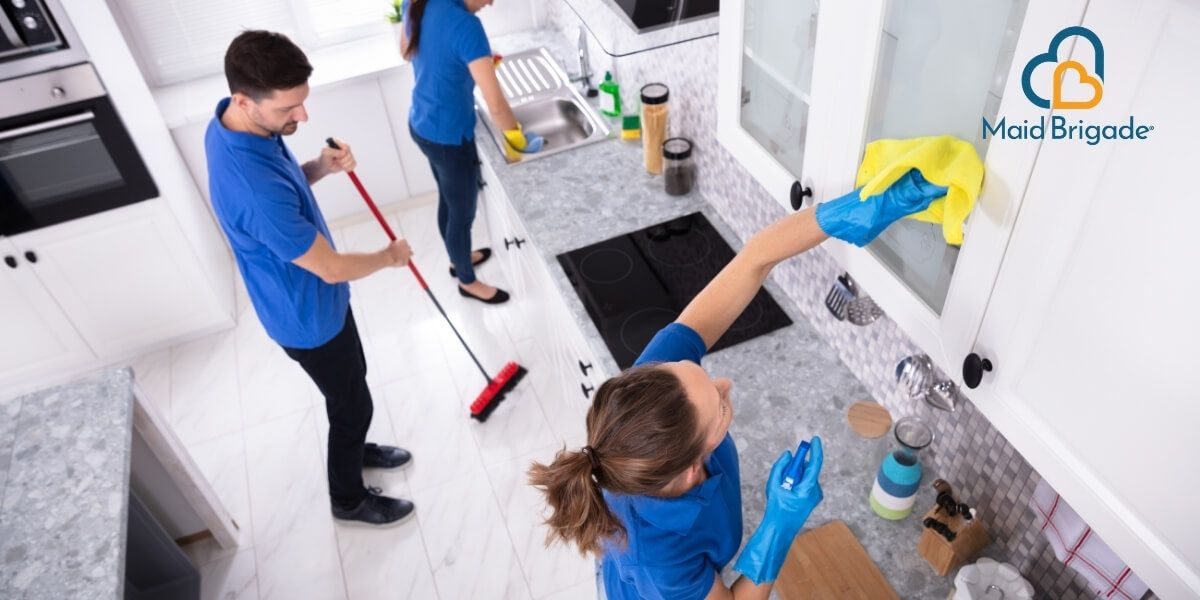
Maid Brigade of Greater Fort Worth is exactly the overlap this guide describes: a locally owned, family-operated business that has served the Fort Worth area since 1989, operating under a national brand. Keith Clem founded it, and Megan Clem has been General Manager since 2016. The national Maid Brigade system was founded in 1979 and is a separate entity from this local business.
The practical consequences sit in the table above. Crews are employees who are trained, background-checked, and covered by liability and workers’ compensation insurance rather than contractors sourced per job. They arrive fully equipped, and the company generates its own cleaning agents on site through its PUREcleaning system. Problems route through a local office backed by a satisfaction guarantee, stating that if you are not satisfied for any reason it will come back to make it right. The ownership question in more detail is in is Maid Brigade a franchise or locally owned. To start with a free, no-obligation quote, ask whatever you want about the local business first.
How do Fort Worth homeowners actually decide?
The households that choose well stop asking about the brand and start asking about the four factors that actually vary: employment status, insurance including workers compensation, cover when someone is unavailable, and whether a written remedy exists.
The households that regret their choice usually optimised on price alone and discovered the insurance gap after a broken item or an injury. That is not an argument that independents are bad, since many are excellent, careful, and fully insured. It is an argument for asking the same four questions of everyone regardless of whether the vehicle carries a national logo. The full pre-hire sequence is in what to ask before hiring a house cleaning company in Fort Worth, and if you would rather just get set up, book a visit.
Key Takeaways
- Most franchise locations are independently owned small businesses, so local versus franchise is a false opposition.
- The International Franchise Association reports more than 80 percent of franchisees own a single location and 94 percent of franchised establishments employ fewer than 50 people.
- What genuinely differs is who employs the crew, who carries insurance, whether cover exists during illness, and whether a written remedy is available.
- The BBB distinguishes a bond, covering dishonest acts, from insurance, covering accidental damage, and advises verifying both with the insurance agent.
- Workers compensation is the exposure most homeowners never consider, since an uninsured cleaner injured in your home may pursue your homeowner’s policy.
- Ask who owns the local business, how long it has operated in this market, and who resolves a complaint, rather than asking about the corporate structure.
FAQ
Is a franchise cleaning company still locally owned?
In most cases yes. The International Franchise Association reports that more than 80 percent of franchisees own a single location and that 94 percent of franchised establishments employ fewer than 50 people. A franchise location typically licenses a brand, a method, and training while employing its own staff, carrying its own insurance, and answering for its own work locally. The useful question is who owns and operates the specific location.
Are independent cleaners cheaper than companies?
Often, and the difference usually reflects overhead the client cannot see. A single operator may carry no employer insurance, no payroll burden, no office, and no arrangement to cover illness or holiday. Many independents are excellent and fully insured. The point is to verify rather than assume, since the saving and the exposure come from the same place.
Does a national brand mean better training?
It usually means standardised training, which is a different claim from better. A franchise system typically requires locations to follow defined methods and meet defined standards, which produces more consistency across visits and across crews. Whether that matters to you depends on how much you value predictability against a personal relationship with one individual who cleans your home every time.
What is the difference between bonded and insured?
The Better Business Bureau explains that a bond is a form of insurance protecting you against dishonest or criminal acts by the people entering your home, while insurance protects you if the cleaners cause an accident such as leaving a faucet running or losing a key. They are separate protections and a company can carry one without the other, which is why you should ask about each specifically rather than accepting a general assurance.
Why does workers compensation matter to me as a homeowner?
Because the exposure lands on you if it is absent. The BBB advises verifying that a cleaning company carries its own workers compensation policy, warning that if it does not and a cleaner is injured in your home, they could pursue you and your homeowner’s insurance policy. This is the single most overlooked risk in hiring cleaning help, and it applies regardless of whether the business is branded.
How do I check a local company is legitimate?
Ask for a copy of the bond and the name of the insurance agent, then call the agent to confirm the policies are in effect, which is exactly what the BBB recommends. Then ask three local questions: how long this location has operated in this market, who owns it, and who handles a complaint. Finally, get the scope in writing before the first visit.
Bottom Line
The local versus franchise question is the wrong question, because most franchise locations are locally owned small businesses. What actually varies between any two cleaning services is employment status, insurance including workers compensation, cover when a cleaner is unavailable, and whether a written remedy exists. Ask those four things of everyone, verify the insurance with the agent rather than the salesperson, and get the scope in writing.
Sources
- Is Maid Brigade a franchise or locally owned for the ownership question in detail.
- Cleaning company vs solo independent cleaner in Fort Worth for the operator comparison.
- Are cash-only independent cleaners worth the savings for the payment and classification angle.
- What happens if a house cleaner breaks something for the liability mechanics.
- How to verify a cleaning company’s bond and insurance for the verification process.
- What to ask before hiring a house cleaning company in Fort Worth for the full pre-hire sequence.
- International Franchise Association, the value of franchising: more than 830,000 franchise establishments, more than 80 percent of franchisees owning a single location, and 94 percent employing fewer than 50 people.
- Better Business Bureau, tips for hiring a house cleaning service: the bond versus insurance distinction, verifying policies with the agent, the workers compensation warning, and the written agreement recommendation.
- United States Department of Labor, employee misclassification under the Fair Labor Standards Act: why classifying an employee as an independent contractor removes minimum wage, overtime, and other legal protections.