
How Long Does a House Cleaning Take in a Fort Worth Home?

By Maid Brigade of Greater Fort Worth, serving Fort Worth and the Mid-Cities since 1989. Editorial verification September 9, 2026.
Last updated: 2026-09-09
Verified against ISSA published guidance on calculating cleaning times, Asthma and Allergy Foundation of America dust mite guidance, and Centers for Disease Control and Prevention cleaning and disinfection guidance on September 9, 2026. No estimate in this guide is presented as a Maid Brigade time quotation; timing for any specific home comes from a walkthrough. Desk verification of published sources is the method used here.
TL;DR: There is no honest single answer, because cleaning time is driven by fixture count and agreed scope rather than by square footage alone. Two 2,500 square foot Keller homes can differ by hours if one has four bathrooms and the other has two. The industry estimates by counting fixtures and tasks, and any company quoting a duration without asking about bathrooms, pets, or clutter is guessing.
Three things frustrate people about this question. Every company gives a different answer. The number quoted on the phone rarely survives the first visit. And nobody explains why a smaller house sometimes takes longer than a bigger one. The industry’s own guidance is clearer than the marketing: ISSA, the cleaning industry association, publishes a fixture method in which “cleaning time can be calculated as the number of fixtures to be cleaned multiplied by the production rate in minutes”.
This guide covers what actually drives duration, how professionals estimate it, why the first visit takes longest, the four things that reliably add time, and how to get a number you can hold someone to.
How long does a house cleaning take?
Long enough to complete the agreed scope, which is a real answer rather than an evasion. Duration is a function of how many discrete things must be cleaned and how thoroughly, not of floor area. A house with four bathrooms, three of them with glass shower enclosures, carries far more work than its square footage suggests.
The useful reframe is that you are not buying hours, you are buying a completed scope. A crew of three finishing in ninety minutes has delivered the same thing as one person working four and a half hours. If a company quotes you time rather than scope, ask what is included, because time without scope is not a commitment to anything.
Why does square footage predict duration so poorly?
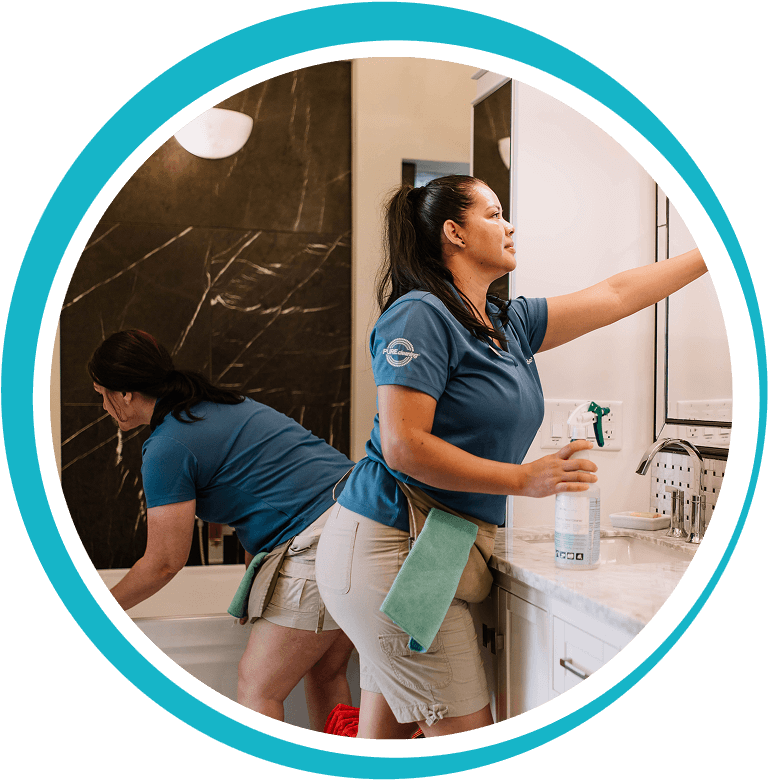
Because most cleaning work is concentrated in fixtures and detail, and those do not scale with floor area. A large open living room adds floor to vacuum and almost nothing else. A compact bathroom adds a toilet, a sink, a mirror, a tub or shower, fixtures, and grout lines, all of which need individual attention.
ISSA’s published method reflects this directly. Alongside area-based calculations, it offers the fixture method precisely because some work counts in items rather than in square feet. Brant Insero, Chief Engagement Officer for ISSA, is explicit that the published tables are “not a time-motion study; their purpose is to act as a guide for bidding and estimating cleaning work”. They are benchmarks compiled from thousands of sources, and they exist for estimating, not for promising a homeowner a stopwatch figure.
What actually adds time to a visit?
Four things dominate, and they are worth naming because you control three of them. Bathroom count is the largest single driver, followed by kitchen condition, then clutter on surfaces, then pets.
| Driver | Effect on duration | Do you control it |
|---|---|---|
| Number of bathrooms | Largest single driver | No |
| Kitchen condition and appliance interiors | Substantial, especially first visit | Partly |
| Clutter on horizontal surfaces | Significant, crews must clear before cleaning | Yes |
| Pets and pet hair | Adds vacuuming passes and hair removal | Partly |
| Deep clean versus standard scope | Changes which surfaces are in scope at all | Yes |
| Access, parking, alarm handling | Small but real, especially in gated communities | Partly |
The clutter row is the one most worth acting on. A crew that has to clear a counter before wiping it is doing two jobs, and the guide to what to expect at your first house cleaning and how to prepare covers what is genuinely worth doing beforehand.
Why does the first visit take longest?
Because the first visit is doing work that no subsequent visit repeats. Accumulated soil in places that have never been professionally cleaned takes time to remove once, then routine maintenance holds it. Crews are also learning the house: which surfaces are delicate, where things belong, what the household actually cares about.
This is why a first visit is frequently scoped as a deep clean rather than a standard one, and why the difference matters financially. The distinction between the two is worked through in deep clean vs standard clean. Judging a company by how long the first visit takes is a mistake, because that visit is not representative of the ongoing relationship.
How long does a deep clean take compared with a standard clean?
Substantially longer, because a deep clean adds surfaces rather than adding care. Baseboards, door frames, ceiling fan blades, vent covers, window sills and tracks, blinds, cabinet fronts, and floor edges are all in scope on a deep clean and largely out of scope on a standard one.
The multiplier depends entirely on how long it has been since the house was reset. A home that has been professionally maintained for a year takes far less deep-cleaning time than one that has never had it done. Rather than quoting a ratio that will be wrong for your house, request a free, no-obligation quote and describe the current state honestly, since an accurate description gets you an accurate estimate.
How long does a move-out clean take?
Longer than an occupied deep clean of the same house, which surprises people who assume an empty home is faster. Empty rooms expose every surface furniture was hiding: floor edges, wall marks, closet interiors, the footprint under appliances. The standard being applied is also somebody else’s rather than yours.
For renters this matters financially, because Texas law lets a landlord deduct for damage but not for ordinary deterioration. The mechanics are covered in move-out cleaning for apartments in Bedford, Euless and Hurst and, for larger properties, move-out cleaning in Southlake, Keller and Colleyville.

Does a home with allergies or pets take longer?
Yes, and for a reason worth understanding rather than resenting. The work that reduces allergen load is time-intensive by nature: vacuuming slowly enough for the machine to actually capture fine particles, wiping with damp microfiber rather than dry dusting, and reaching the fabrics and vents where allergens accumulate.
The Asthma and Allergy Foundation of America recommends washing bedding weekly “in water that’s at least 130 F or more to kill dust mites” and using “a vacuum cleaner with a HEPA filter weekly”. Fast vacuuming is one of the least effective things anyone can do in an allergy household, because the machine needs dwell time on each pass. If speed is being sold as the headline benefit, that is a signal worth noticing. The local detail is in pet dander and odor cleaning for Fort Worth dog and cat owners.
Should a faster clean worry you?
Sometimes, and the tell is not the clock but the sequence. Disinfection in particular cannot be rushed, because every registered disinfectant requires the surface to stay visibly wet for a stated contact time. Spraying and immediately wiping forfeits the claimed efficacy entirely.
The Centers for Disease Control and Prevention also requires that you “clean the surface with soap and water first” before disinfecting. A crew moving fast because it is well-practiced and well-staffed is fine. A crew moving fast because it is skipping the clean-first step or wiping disinfectant off early is not. Ask which surfaces are disinfected and how long they stay wet.
What does Maid Brigade of Greater Fort Worth do differently?
Maid Brigade of Greater Fort Worth sends teams rather than individuals, which compresses the elapsed time a household loses without compressing the work itself. Crews arrive fully equipped, so no part of the visit is spent locating or assembling the homeowner’s supplies, and the company generates its own cleaning agents on site from salt, water, and electricity through its PUREcleaning system.
Two operational details affect duration in practice. Crews work a multi-fiber cloth system intended to prevent cross-contamination between rooms, which is a deliberate sequence rather than a speed optimisation. And the company backs its work with a satisfaction guarantee, stating that if you are not satisfied for any reason it will come back to make it right, which is the practical remedy when something was genuinely missed. Team consistency is covered in does Maid Brigade send the same cleaning team every time. To get a duration estimate for your own house, book a visit.
How do Fort Worth homeowners actually decide?
They stop asking how long and start asking what is included, which is the shift that makes the whole question tractable. A written scope is enforceable. A verbal duration is not.
Three questions get you there. Which rooms and which surfaces are in scope, written on the work order? Is this priced as a deep clean or a standard clean, and which am I actually getting on the first visit? And what happens if something on the list was missed, meaning is there a defined remedy? Any company that answers those clearly has told you far more than an hour estimate ever would. For the wider checklist, see what to ask before hiring a house cleaning company in Fort Worth, or contact the office to walk through your own home.
Key Takeaways
- Cleaning duration is driven by fixture count and agreed scope rather than by square footage, which is why two similar-sized homes can differ by hours.
- ISSA’s published guidance offers a fixture method precisely because some cleaning work counts in items rather than in floor area.
- ISSA states its published times are not a time-motion study and exist as a guide for bidding and estimating, not as a promise of duration.
- The first visit takes longest because it removes accumulated soil that no later visit repeats, so it is not representative of ongoing service.
- Bathroom count, kitchen condition, surface clutter, and pets are the four dominant drivers, and you control the middle two.
- A fast visit is only a problem when speed comes from skipping the clean-first step or wiping disinfectant off before its contact time.
FAQ
How long does a standard house cleaning take?
Long enough to complete the agreed scope, which varies far more with fixture count than with square footage. A three bathroom home carries considerably more work than a one bathroom home of the same floor area, because bathrooms concentrate fixtures, glass, and grout. Rather than accepting a duration over the phone, ask which rooms and surfaces are included and get that written on the work order, since scope is what you can actually hold a company to.
Why did my cleaning take less time than quoted?
Usually because a team of several people finished a scope that the quote assumed would take one person longer, which is a legitimate difference rather than a shortfall. The question worth asking is whether everything on the agreed list was completed, not how many minutes elapsed. If items were missed, that is a scope conversation with a defined remedy. If the list was completed, you received what you paid for.
Does a bigger house always take longer to clean?
No, and this catches people out regularly. Floor area adds vacuuming and mopping, which is relatively fast per square foot. Bathrooms, kitchens, and fixture-dense rooms add disproportionate work. A compact house with three bathrooms and a heavily used kitchen can take longer than a larger house with two bathrooms and open living space. This is why professionals estimate by counting fixtures and tasks.
How much does clutter slow down a cleaning?
Significantly, because a crew that must clear a surface before cleaning it is effectively doing two jobs. Clearing horizontal surfaces of papers, dishes, toys, and personal items before the crew arrives is the single highest-value thing a household can do to make a visit more productive. You are not expected to clean before the cleaners come, but clearing surfaces is different from cleaning them.
Should I book a longer visit for a deep clean?
A deep clean is scoped differently rather than simply booked longer, which is an important distinction. It adds surfaces that a standard clean never touches: baseboards, vents, ceiling fans, blinds, window tracks, and floor edges. Ask for it explicitly as a deep clean rather than asking for extra time on a standard clean, because extra time on a standard scope means more care on the same surfaces, not different surfaces.
Is a two hour cleaning enough for my house?
That depends entirely on how many bathrooms it has, what condition the kitchen is in, how much is on the surfaces, and whether you want a standard or deep scope. Any company able to answer that question without asking those four things is guessing. The productive move is to describe your home honestly and ask what scope fits a given budget, rather than fixing the hours and hoping the scope follows.
Bottom Line
Cleaning time is set by fixtures and scope, not floor area, which is why the industry’s own estimating guidance counts items rather than square feet. Stop negotiating hours and start negotiating a written scope, since that is the only part you can enforce. Watch for speed that comes from skipping the clean-first step rather than from good staffing. For an estimate based on your actual home, request a free, no-obligation quote.
Sources
- Deep clean vs standard clean for what changes when scope expands.
- What to expect at your first house cleaning and how to prepare for why the first visit runs longest.
- Move-out cleaning for apartments in Bedford, Euless and Hurst for empty-property timing.
- Move-out cleaning in Southlake, Keller and Colleyville for larger properties.
- Pet dander and odor cleaning for Fort Worth dog and cat owners for why allergen work is time-intensive.
- Does Maid Brigade send the same cleaning team every time for crew consistency.
- What to ask before hiring a house cleaning company in Fort Worth for the wider checklist.
- ISSA, how to calculate cleaning times: the fixture method formula, and Brant Insero’s statement that the published times are a bidding guide rather than a time-motion study.
- Asthma and Allergy Foundation of America, dust mite allergy: the 130 degree wash temperature and weekly HEPA vacuuming guidance.
- Centers for Disease Control and Prevention, when and how to clean and disinfect: the requirement to clean before disinfecting.